Design Nomenclature / Digital Model Making
Voxel Modeling
Also called voxels, volumetric modeling, voxel remesh
This entry has not been translated yet and is shown in English.
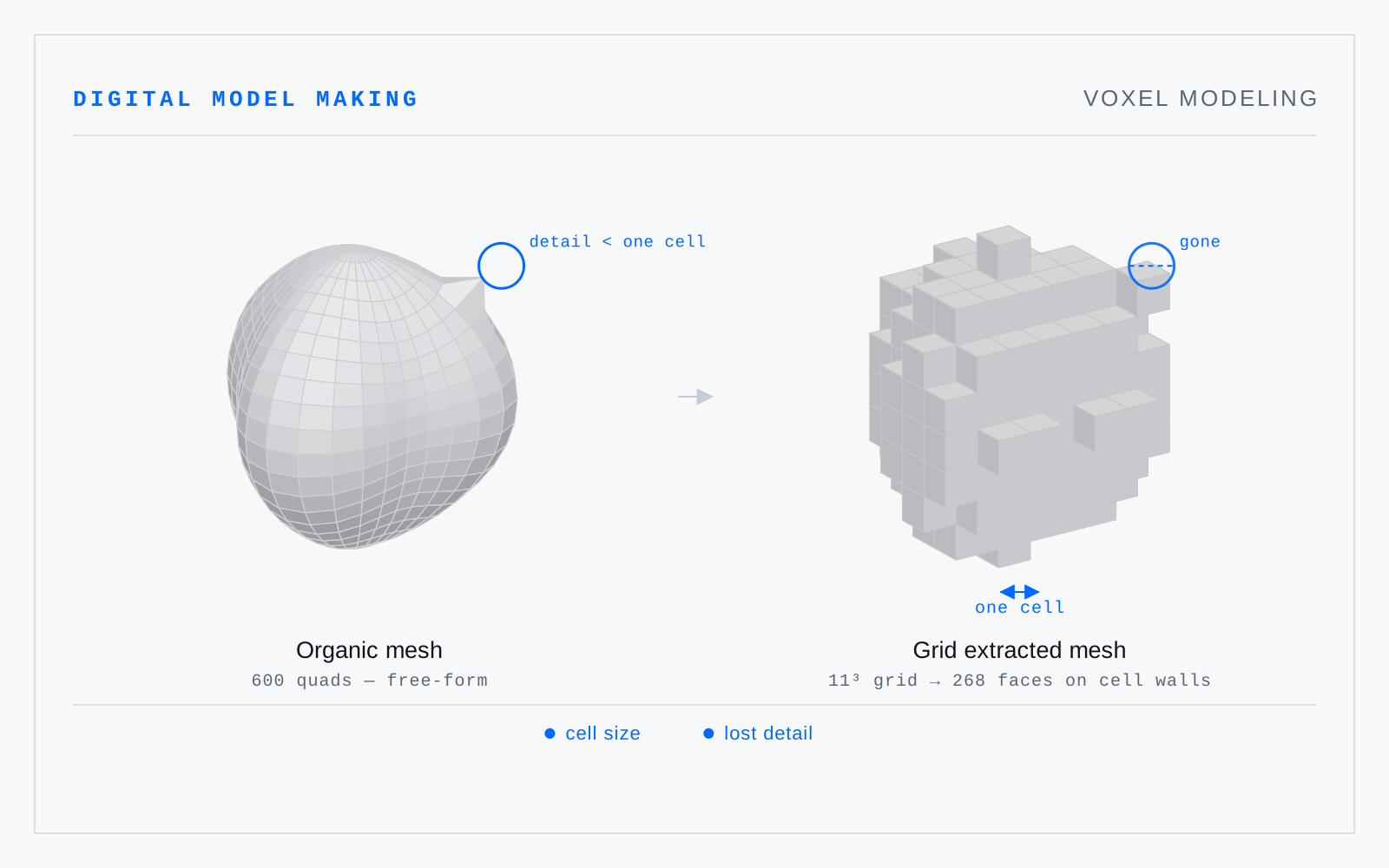
Working on a regular 3D grid of samples, each cell occupied or carrying a value. Topology changes are trivial — you are editing an array, so self-intersection is not expressible — but resolution is fixed and isotropic, memory scales cubically, and every surface must be extracted by an isosurface pass that leaves a grid signature.
In practice
Covers both cube-art tools and the volumetric layer inside sculpting apps, where “voxel remesh” quietly means rasterize to a grid and re-extract. The output is a mesh.
Not to be confused with
- SDFForm defined as a function returning the distance from any point to the nearest surface — negative inside, positive outside. The surface is the zero level set and is never stored. Booleans become min and max, offsets become addition, blends become a smooth minimum, and the result is watertight by construction.
- Point CloudAn unstructured set of measured 3D points, often with colour and estimated normals, and with no connectivity: no edges, no faces, no surface. It is data, not a model. Everything downstream — meshing, normal estimation, hole filling — is inference, and noise, occlusion, and registration error are already in it.
- RemeshReplacing a mesh's topology wholesale with a new, evenly distributed one approximating the same surface. Voxel remeshers rasterize to a grid and re-extract, guaranteeing watertightness and losing everything below cell size; quad remeshers fit a quad field, optionally guided, and get closer to a layout someone could work with.
Origin
Volume plus pixel, coined on the pattern of pixel from picture element. The word promises a three-dimensional pixel and delivers exactly that — including the fixed grid and the aliasing that comes with it.