Research
Work that outlives the deadline.
Some questions are worth studying past the point a project requires. This is where that work lives: a long-running program on readable type, field notes from autonomous survey hardware, and technical writing on building software people can understand and trust.
01Typography & accessibility
The Universal Web
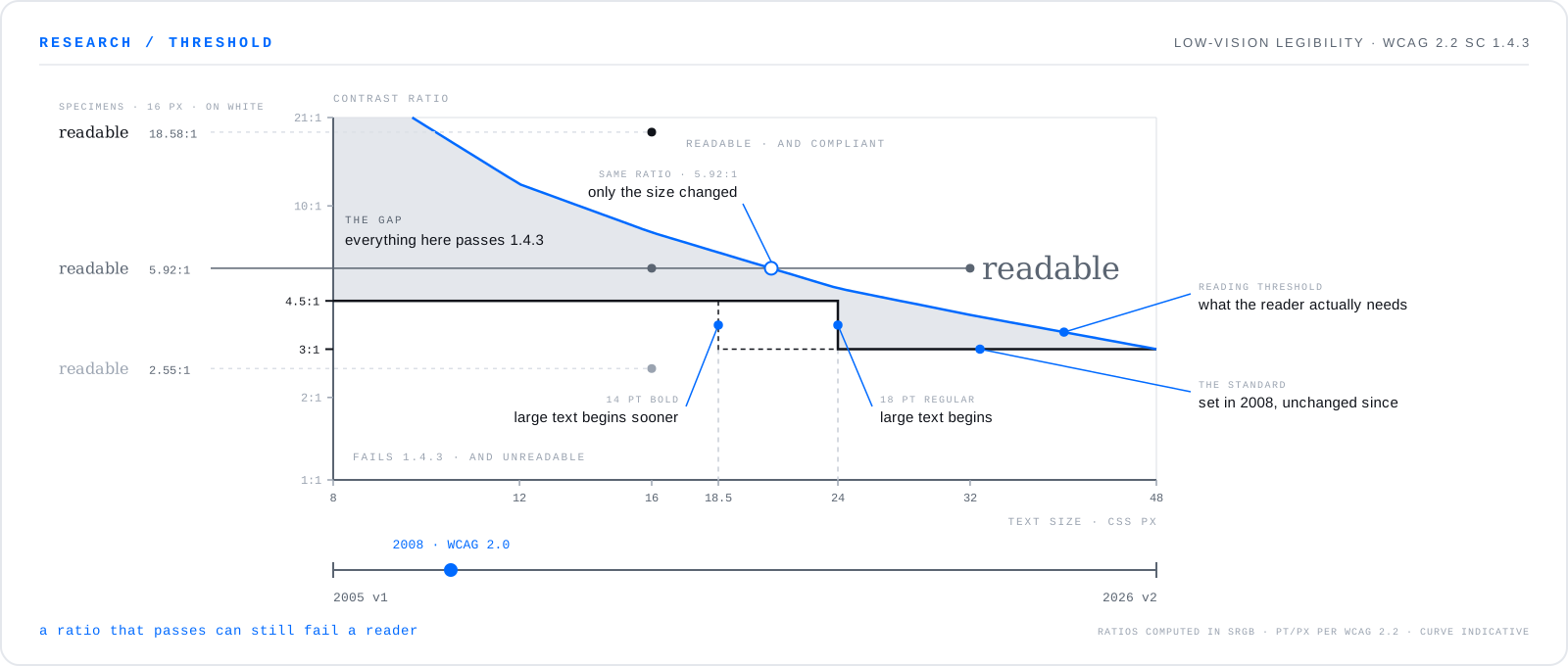
A field guide to readable type on screen, begun at the Rhode Island School of Design and revised for the modern web across 21 chapters. It retests twenty-year-old low-vision-legibility findings against high-density displays, variable fonts, and WCAG 2.2. The historical record is preserved and clearly separated from present-day commentary.
02Autonomous & geospatial
Field & survey notes
A drone-borne magnetometer survey program in western Colorado: sensor and airframe integration, flight-log analysis, and turning raw magnetic data into interpreted maps. The write-up covers the systems thinking and hardware/software integration without publishing sensitive locations or proprietary data.
03Technical writing
A Field Kit in PETG
Eighty-odd printed parts hold a flying magnetometer together: clamps, cradles, couplers, and a towed sensor pod, all printed overnight on a desktop machine. Notes on 3D printing as a field-engineering practice, revision by revision.
Designing for an Invisible Constraint
A drone that measures magnetic fields cannot be built like other drones: every screw is a design decision. What a survey aircraft taught me about constraint-first design — a lesson twenty years of typography had already tried to teach.
The Agent in the Workshop
I gave Claude three specialized subagents — a mount designer, an OpenSCAD author, and a print checker — and let them iterate real drone parts through eighteen logged revisions. Notes on what AI-assisted mechanical design actually looks like.
The Performance Budget of a Typeface
If the brand face earns its place, make it cheap: one variable file instead of four statics, ruthless subsetting, honest font-display, and a fallback engineered so the swap is invisible. Font loading as an engineering discipline.