Field ReportMoffat County, Colorado
Mineral Exploration.
The West Side Placer: a gold and rare-earth heavy-mineral-sand project in the high sage country of northwest Colorado. Discovered in 1894, examined by a century of engineers, revived in the 1980s — and now the subject of a modern critical-minerals program built on ten years of fieldwork, four independent laboratories, and a federal research grant.
Operated by AuPt Industries LLC. Commercial terms and valuations are not published; history, geology, and methods are.
Contents
- 01The West Side PlacerA gold and rare-earth placer field in the high sage country of Moffat County, Colorado — discovered in 1894, worked in three eras, and now the subject of a modern critical-minerals program.3 min read
- 02A Field Discovered: 1894A prospector named Adams finds gold in the terraces in 1894; within a year, eastern investors are building a 36-mile canal across the sage to wash it — one of the boldest placer gambles of its era.3 min read
- 03The Hoover FileBetween the 1890s failure and the 1980s revival, the district drew a string of serious engineering examinations — including a file in the Colorado School of Mines special collections connecting the ground to Herbert Hoover.3 min read
- 04The 1980s RevivalCentennial Gold and Marathon return to the field with modern gravity equipment, produce roughly nine hundred ounces in a season, and field an approach from a French chemical giant about the monazite — before the gold price ends the program.3 min read
- 05Geology of the TerracesPliocene–Pleistocene river terraces blanket the district in ten to forty feet of gravel — heavy-mineral sands shed from Archean granite highlands and concentrated by millions of years of shifting rivers.3 min read
- 06Rare Earths in the Black SandMonazite makes up a quarter to a third of the heavy-mineral fraction — an order of magnitude above the placers that fed America's historic rare-earth supply — with a neodymium-praseodymium-rich profile aimed at the magnet supply chain.3 min read
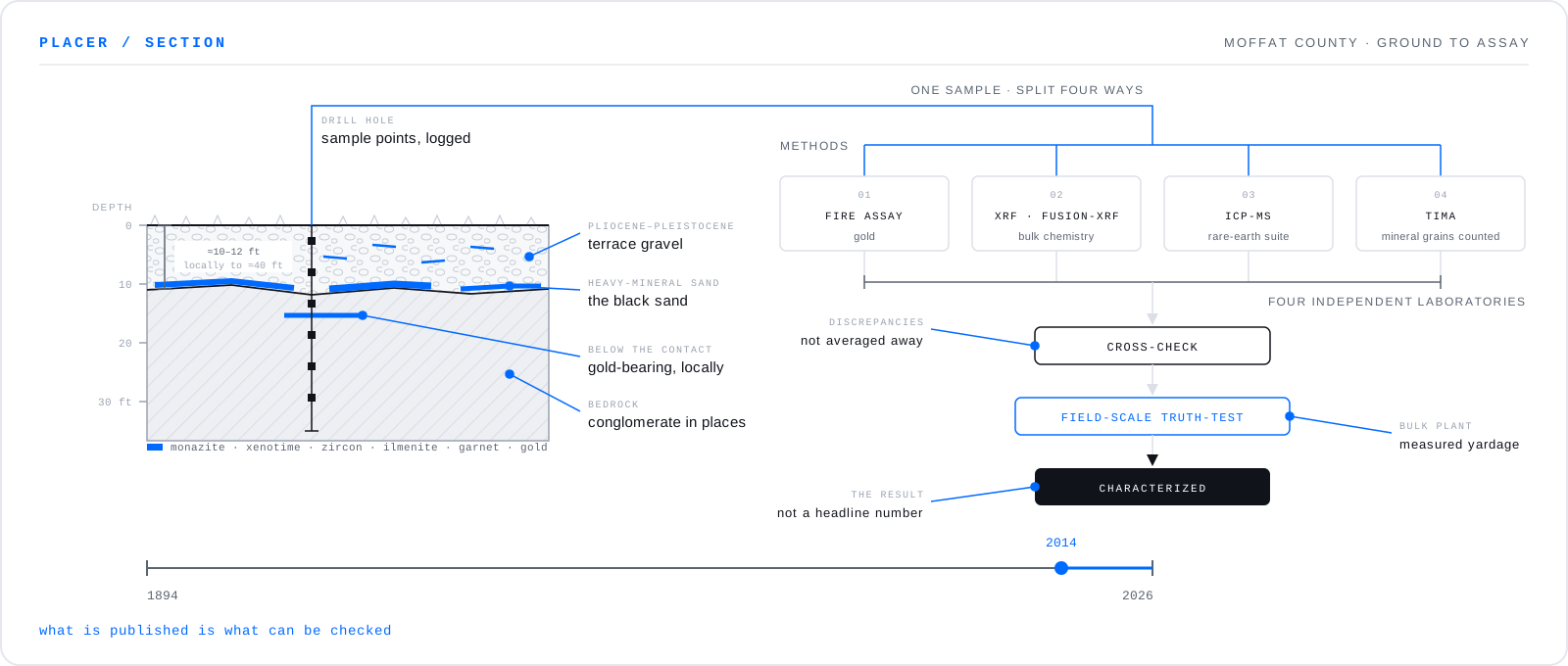
- 07Proving the GroundA decade of fieldwork in sequence: district reconnaissance in 2014, permitted bulk sampling from 2016, drilling, and an assay program spread deliberately across independent laboratories so no single result could flatter the project.3 min read
- 08Clay, the King's ThiefKaolinite clay coats the gold, armors the gravel, and steals fines from every careless circuit — the single variable that has governed recovery on this field since 1895, and how the modern flowsheet finally deals with it.3 min read
- 09Permits, Water, and ReclamationThe unglamorous record that makes everything else possible: state mineral leases, limited-impact and hardrock permits, BLM claims maintenance, water rights, posted reclamation bonds — and a low-impact operating ethos suited to a working landscape.3 min read
- 10The DOE Grant and What Comes NextThe project joins the Department of Energy's CORE-CM critical-minerals initiative for the Green River Basin — a coalition with academic partners to assess the basin's rare-earth sands — and the data library becomes the founding use case for an AI platform.3 min read