In 2021 the story widened from one placer field to an entire basin. The U.S. Department of Energy's CORE-CM initiative — Carbon Ore, Rare Earth and Critical Minerals — set out to assess and develop critical-mineral resources basin by basin across the country, and the West Side Placer became the anchor of a funded proposal for the Green River Basin region of Colorado and Wyoming.
The Project
Titled West Side Placer & the Heavy Mineral Sands of the Green River Basin, the effort was proposed with AuPt Industries as lead and a coalition including academic partners — among them geoscience faculty at Colorado College — and regional collaborators. The premise is the one this whole section has been building toward: the monazite-rich sands of the West Side terraces are not an isolated curiosity but one expression of a basin-scale heavy-mineral system shed off some of the oldest rocks in North America — and the basin deserves a modern, systematic accounting as a domestic source of magnet rare earths, recovered by low-impact surface methods rather than hardrock mining.
Federal review of the era's CORE-CM proposals graded the project's technical case; the full application — geology, work plan, coalition letters — remains one of the most complete technical statements of the project on file.
Where the Data Went Next
By the time the grant application was assembled, the project's library held well over a century of material: 1890s association records, journal accounts, the Hoover-era examinations, 1980s corporate reports, four laboratories' assay certificates, drill logs, GIS layers, permit files, and season after season of field notes. Assembling any single coherent claim — what is the average heavy-mineral content of terrace three? — meant a human reading across dozens of documents written decades apart in incompatible vocabularies.
That pain became a product. The West Side data library is the founding use case for Docutron, the document-intelligence platform elsewhere in this portfolio: fifteen specialized AI agents that turn raw project documents — drill logs, permits, surveys — into cited, compliant technical reports, with every claim traced to a source document and page. Its strict anti-hallucination design is not an abstract feature; it exists because in mineral reporting, an uncited number is a liability with a dollar sign on it.
What Comes Next
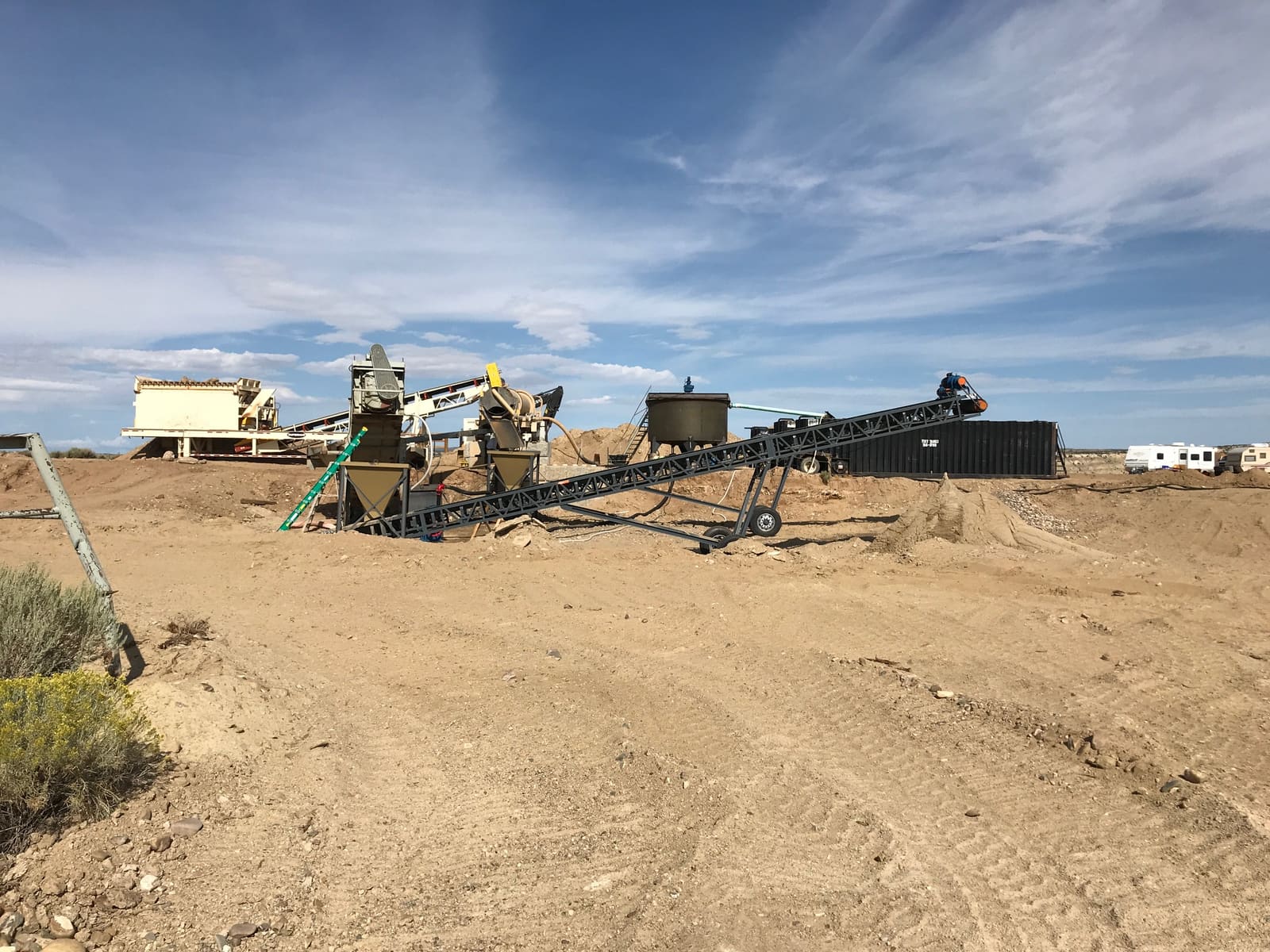
The path forward runs on three tracks: continued characterization of the wider terrace system under the basin-assessment framework; concentrate-scale work with domestic rare-earth processing partners, where the mineralogy has already been judged compatible with existing U.S. flowsheets; and the continued, patient permitting that keeps every option honest.
Three eras chased the gold and were early about everything else. The bet of the current era is that the field's real deposit was always threefold: the metal in the gravel, the rare earths in the black sand — and the century of documentation that taught a designer how to build machines that read.