The modern chapter of the West Side Placer begins in the early 1980s, when rising gold prices sent professional operators back across the old districts of the American West with equipment the canal-era miners could only have dreamed of.
Centennial and Marathon
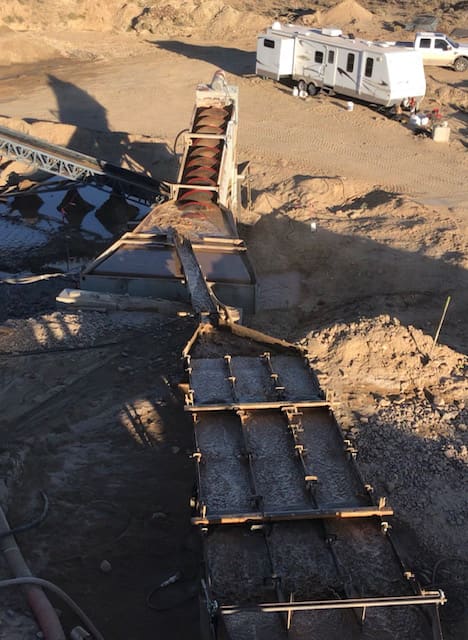
Two companies did the serious work: Centennial Gold and Marathon, whose programs judged the West Side ground the largest and richest placer field in the district. Where the 1890s had thrown water and mercury at the problem, the 1980s brought engineered gravity separation — Reichert cone concentrators and mineral spirals, the same technology family that built the great mineral-sand industries of Australia and the American Southeast.
It worked. In its best season, the Centennial operation recovered approximately nine hundred ounces of gold — proof, on production scale, that the fine gold the old examiners had measured could actually be captured. The recovery flowsheet details survive in the project archive, and they read like a direct ancestor of the modern program: scrub the gravel, concentrate by gravity, deal honestly with the clay.
The Phone Call About the Black Sand
Then came the detail that, in hindsight, reads like the future announcing itself. The gravity circuits that caught the gold also concentrated the heavy black sands — and those concentrates were so rich in monazite that they drew commercial interest from Rhône-Poulenc, the French chemical group that was then the western world's dominant rare-earth processor.
In the early 1980s, rare earths were an obscure specialty market and the inquiry came to nothing. When the gold price fell later in the decade, the whole program lapsed, the equipment was pulled, and the field went quiet again. The monazite went back to being sand.
What the Revival Proved
The 1980s program settled questions the project still relies on:
- Commercial recovery is achievable. Nine hundred ounces in a season is not a pan sample; it is an operating result.
- Gravity is the right tool. The gold and the heavy minerals both respond to it, and no chemistry is required on site.
- The monazite is real and abundant — abundant enough that the world's leading rare-earth company noticed from across an ocean, decades before "critical minerals" was a phrase in federal policy.