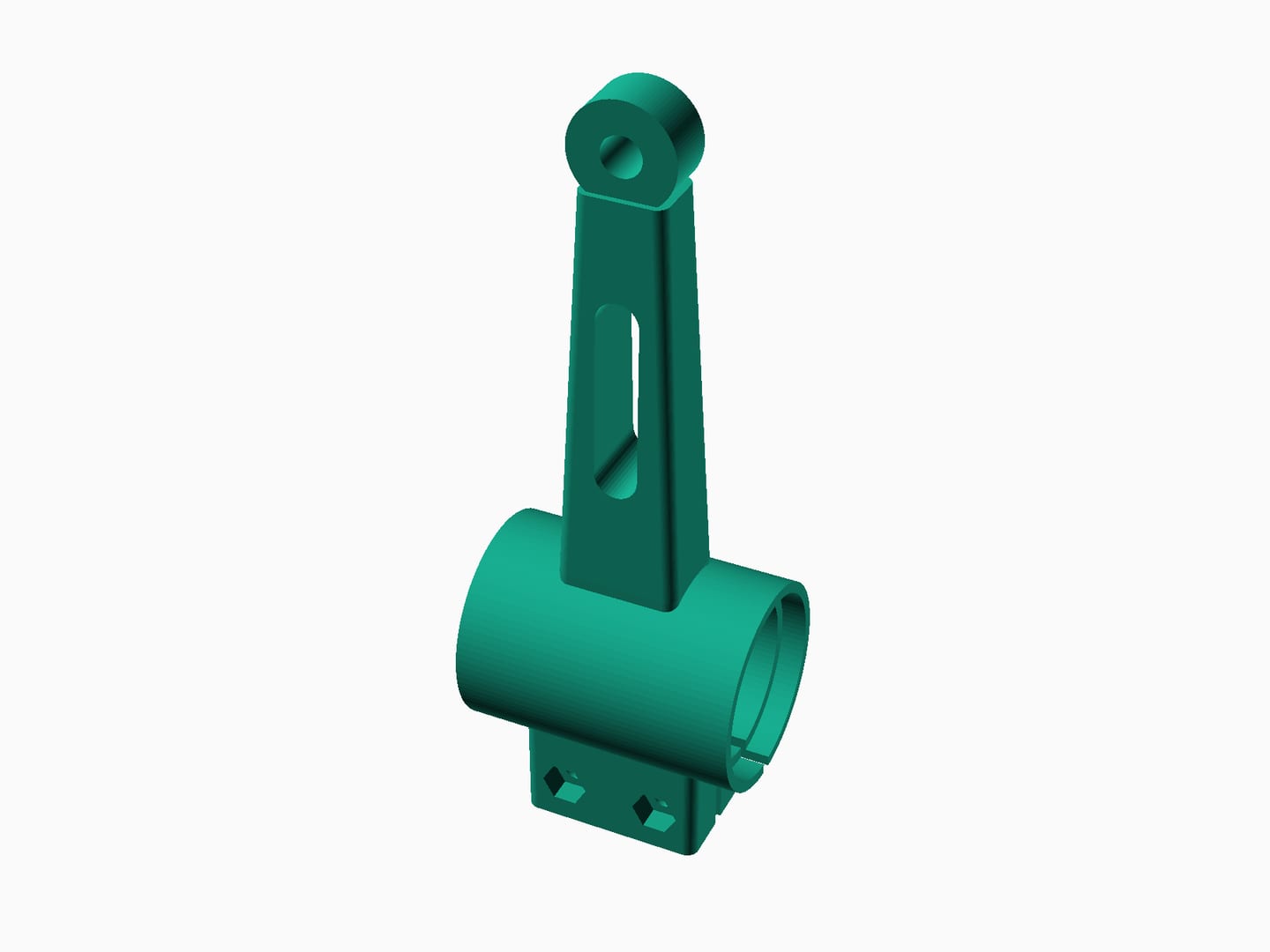
There is a folder on my drive called ai-revision, and every part in it has a suffix: _AI. A magnetometer mount at revision eighteen. A brace-arm clamp at revision six. A towed-sensor pod — nose, fins, hub, yoke — that has never been touched by a mouse. These are real parts, printed in PETG, flying on a survey drone over the Colorado sage. An AI wrote every line of their geometry.
This is a field report on what that workflow actually looks like — not the demo version, the working version.
Three Agents, One Discipline
The setup is a Claude Code project with three specialized subagents, each holding one job and one set of standards:
- The mount designer turns a request into a dimensioned specification. It knows the airframe's tube diameters, the sensor's bolt pattern, and — critically — the project's magnetic hygiene rules: this drone carries a fluxgate magnetometer, so no ferrous hardware, no steel inserts, no neodymium anywhere near the sensor. The designer agent enforces constraints I would forget at 11pm.
- The SCAD author turns the specification into parametric OpenSCAD, following a strict house skeleton: named parameters up top, a revision log in the header, every magic number justified.
- The print checker reviews the geometry as an FDM manufacturing engineer: overhangs past forty-five degrees, walls thinner than three perimeters, orientations that put layer lines across a load path. It rejects parts the slicer would happily ruin.
/new-sensor-mount, /new-bracket, /revise-part. Boring commands are the ones you actually use.
The Loop Closes Itself
The detail that changed my mind about all of this: the agents don't just write geometry, they check it. The project is wired so Claude runs OpenSCAD headless — compiling each revision, rendering preview images, grepping the compiler output for errors — before a human ever sees the part. Code that doesn't compile never reaches me. Geometry that violates the print rules comes back annotated.
The revision headers read like a shop log written by a very patient colleague. Revision 17: clamp bore updated for the new tube outside diameter. Revision 18: sensor attach bolts changed from brass to nylon — magnetic hygiene. That last one is my favorite, because I hadn't asked. The designer agent flagged that even brass hardware sitting centimeters from a fluxgate was worth eliminating, proposed the change, and the author agent carried it through the whole part family.
What the Human Still Does
Everything that matters, honestly — just a different everything. I decide what the drone needs to carry and where the mass can live. I test-fit the prints and report that the clamp needs another two-tenths of clearance because PETG shrinks. I make the call when the print checker and the designer disagree about a support structure. The agents own the geometry; I own the judgment — and the feedback from physical reality that no model has access to.
The result is a design cadence I've never had with traditional CAD: an idea at breakfast is a specification by the second coffee, a compiled STL before lunch, and a printed part being test-fitted the same evening. Eighteen revisions on one mount sounds like churn until you realize each one cost minutes, not evenings.
This workflow eventually became a product — Design Agent AI, which wraps the same idea in a conversational interface with a live 3D viewer. But it started here, in a folder full of _AI suffixes, with a drone that needed parts faster than I could draw them.