Design Nomenclature / Light & Optics
Radiosity
Also called radiosity method, form-factor method
This entry has not been translated yet and is shown in English.
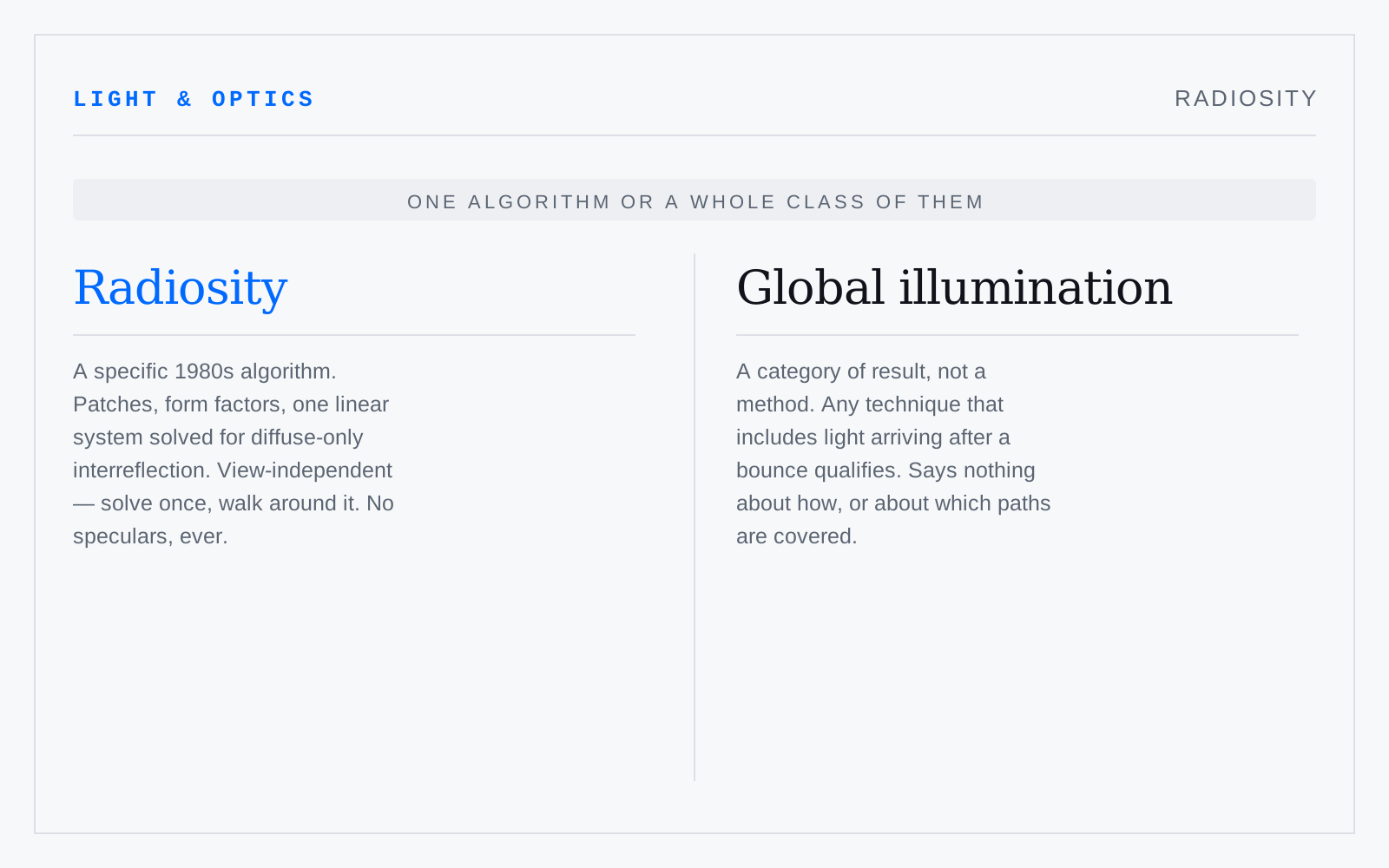
Strictly, a finite-element method that divides a scene into patches, computes form factors between them, and solves the resulting linear system for diffuse interreflection — view-independent, no speculars, and effectively unused since the 1990s. Loosely, and confusingly, the same word gets thrown at global illumination in general.
In practice
It is also a radiometric quantity: flux leaving a surface per unit area, in watts per square metre. Three meanings, one word — say which you mean.
Not to be confused with
- Global illuminationAny solution to light transport accounting for light that arrives after reflecting off other surfaces, not only direct from emitters. It is a category, not an algorithm — radiosity, photon mapping, path tracing, and irradiance caching all compute it, with different biases and different failure modes.
- Path tracingMonte Carlo integration of the rendering equation: follow a random walk from the camera, sampling one scattering direction per bounce, and average many such paths per pixel. Unbiased — noise falls as the square root of the sample count and the estimate converges on the correct answer.
- IrradiancePower arriving per unit area of a surface, in watts per square metre — the cosine-weighted integral of incoming radiance over the hemisphere above it. It is a property of a location, retains no direction, and collapses everything arriving there into a single number.