Design Nomenclature / Light & Optics
Gamma
Also called gamma correction, transfer function, tone response curve, EOTF, OETF
This entry has not been translated yet and is shown in English.
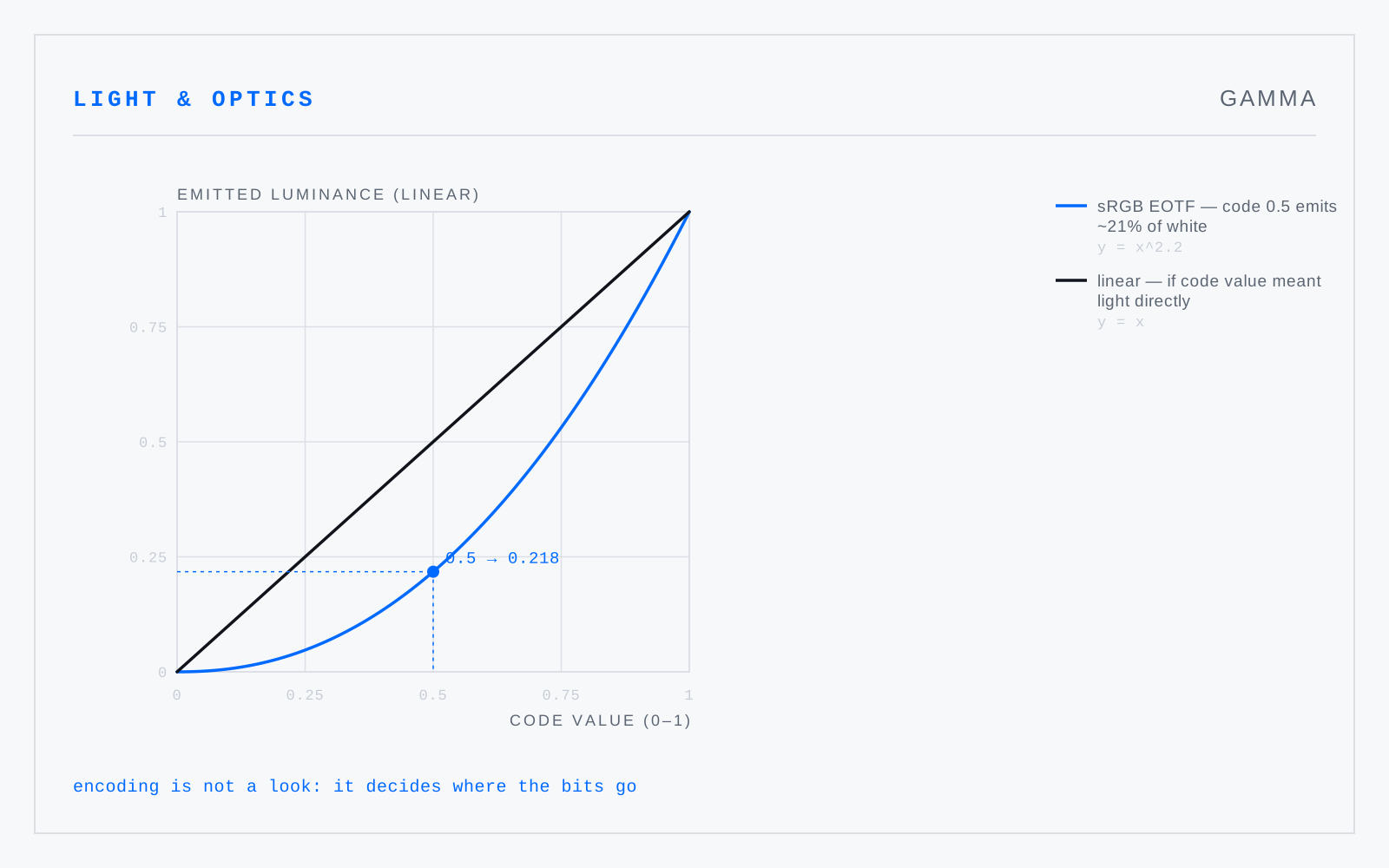
The power-law transfer function between encoded code values and light — historically the CRT's own response near 2.2, now kept deliberately because it spends limited bits where the eye discriminates most finely. sRGB's is piecewise, with a linear toe, averaging roughly 2.2 overall. It is also one of the three things that fix an RGB space, with primaries and white point.
In practice
Not a look and not a brightness knob. Gamma correction names the inverse encoding applied before storage, and most gamma sliders in software are neither. Blending, resizing, and blurring are only correct in linear light: do them on gamma-encoded values and edges darken, gradients sag, and composites carry dark fringes.
Not to be confused with
- Tone mappingThe transform fitting a scene's luminance range into what a display can show — compressing highlights, holding mid-tone contrast, and deciding where things clip. It is neither a colour correction nor optional: some curve is always applied, and choosing none means choosing a hard clip.
- LuminanceRadiance weighted by the eye's photopic sensitivity and integrated over wavelength — candela per square metre. It measures light leaving a surface toward the observer, is what a display's peak-brightness spec quotes, and is linear in energy, so equal steps in it are not equal steps in appearance.
- HDRAs imaging, storing luminance in floating point so nothing clips. As a display standard, a higher peak luminance, a perceptual transfer function — PQ or HLG — in place of a gamma curve, and a wider gamut, with values carried in absolute nits rather than relative to a reference white.
- GamutThe set of colors a device or space can actually produce — a volume rather than an area, since reach changes with lightness. Every gamut is a subset of what the eye sees, and none contains another entirely: sRGB holds blues and greens no press can approach, while coated CMYK reaches yellows and cyans that fall outside sRGB.