Design Nomenclature / Light & Optics
Inverse-square law
Also called 1/r² falloff, inverse square falloff
- Light & Optics
- Systems & Spec
- 2D & 3D
This entry has not been translated yet and is shown in English.
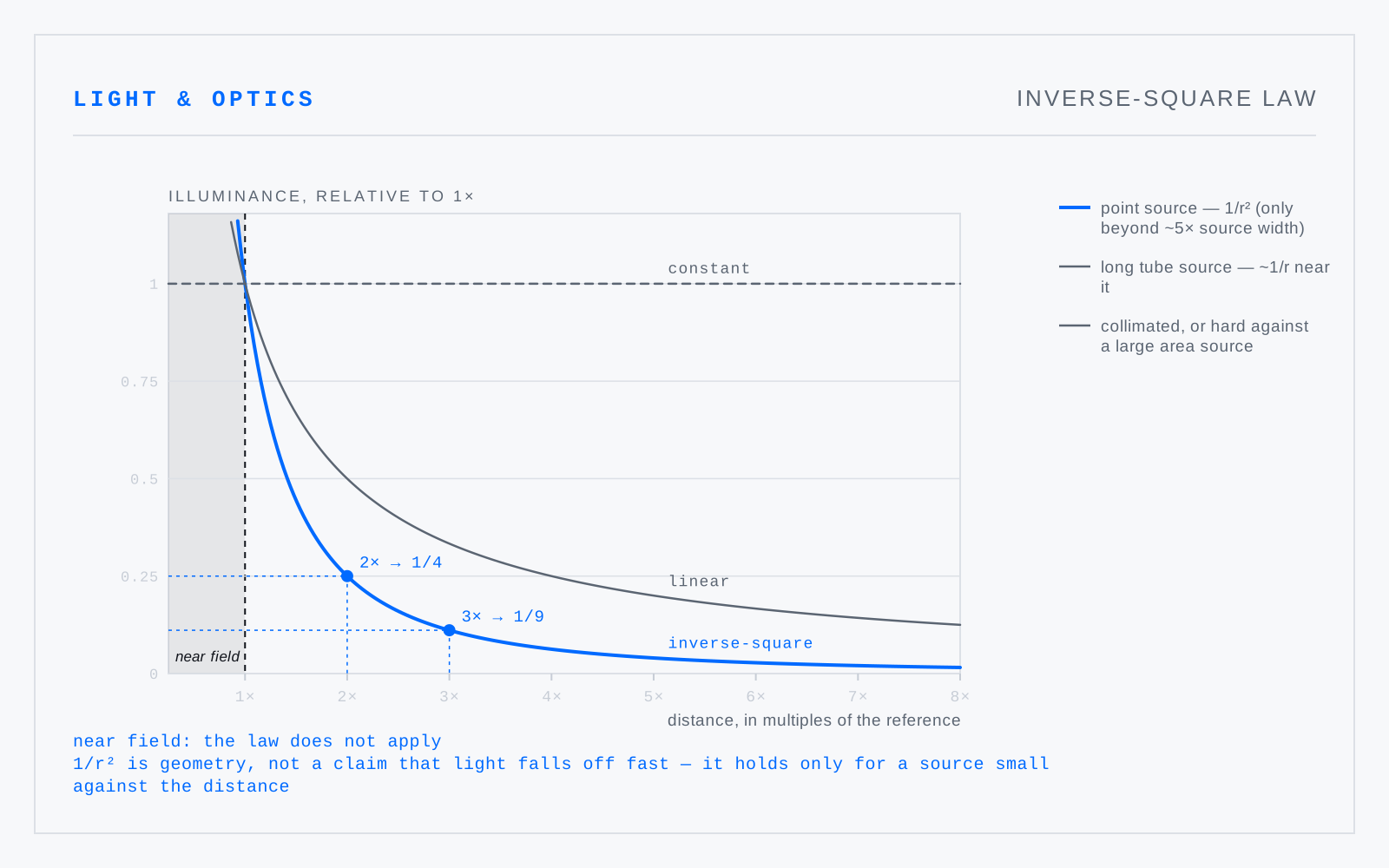
Illuminance from a point source falls as one over distance squared, because the same flux spreads across a sphere whose area grows with the square of the radius. It follows from geometry alone, and it holds only for sources small relative to the distance — roughly five times their own width.
In practice
It is not a claim that light falls off fast. Collimated light does not fall off at all, a long tube fixture goes as 1/r nearby, and against a large softbox the illuminance barely changes with distance.
Not to be confused with
- Point lightAn idealized source of zero extent radiating equally in all directions from a single position. Because it has no size it subtends no solid angle, so it casts geometrically hard shadows with no penumbra whatsoever, and its illuminance obeys the inverse-square law exactly rather than approximately.
- Directional lightA source at effectively infinite distance, so its rays arrive parallel and its illuminance does not vary with position. Shadows stay the same size at any range and the inverse-square law does not apply — the falloff across a set is real but immeasurable. It models sunlight.
- Area lightAn emitter with finite extent — rectangle, disc, sphere, or arbitrary mesh — radiating from every point on its surface. Because different parts of it are visible from different points in shadow, it generates penumbrae natively, and its reflection appears as a specular highlight of matching shape.