Design Nomenclature / Light & Optics
HDRI
Also called image-based lighting, IBL, environment map, environment light, lat-long map, light probe image
This entry has not been translated yet and is shown in English.
A photographic capture of the whole sphere of incident radiance at a point, stored in floating point so the sun stays thousands of times brighter than the sky rather than clipping to white. Used as a source, it supplies direction, colour, softness, and reflection from a real location at once.
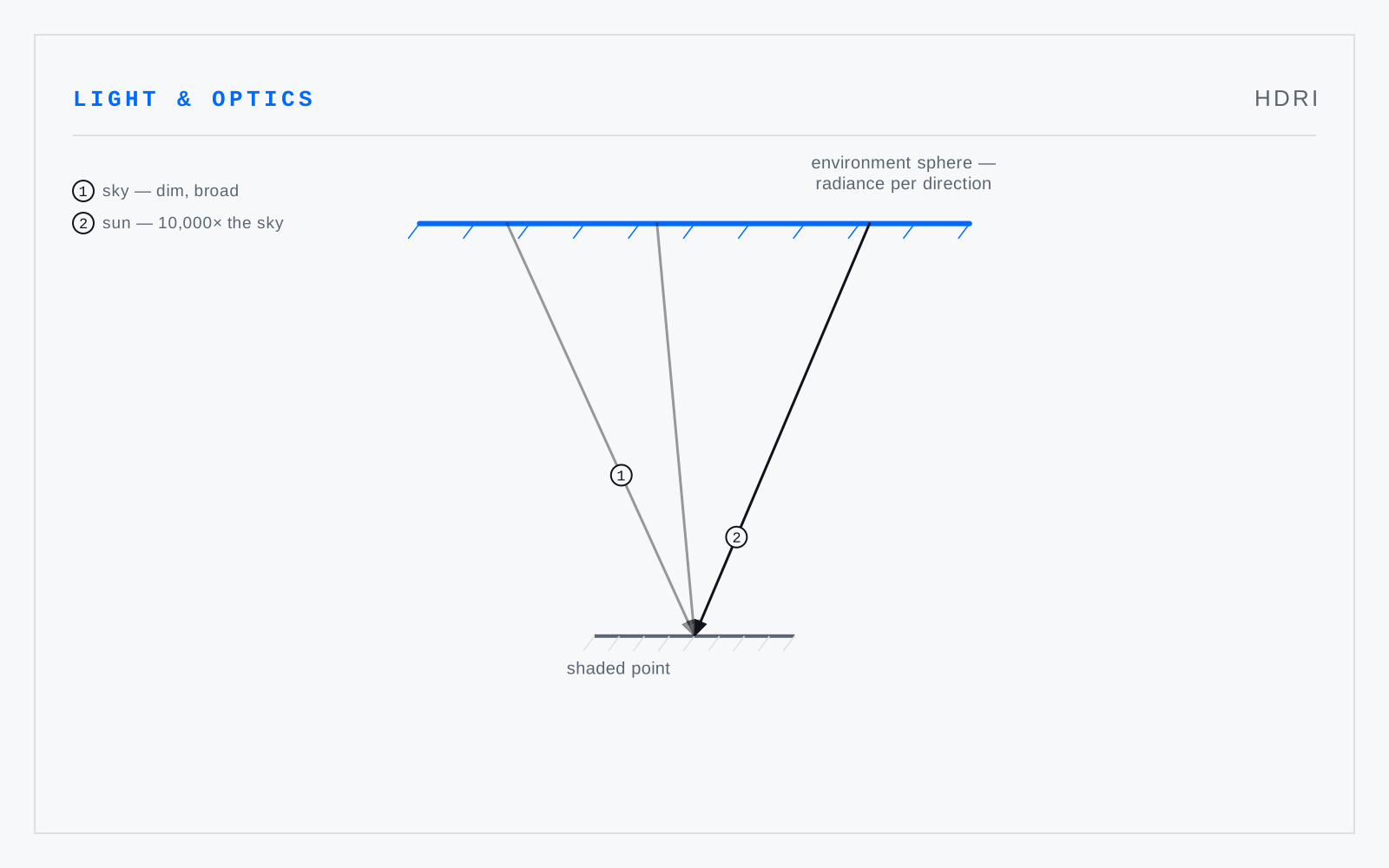
In practice
An 8-bit JPEG in the same slot is not an HDRI. With the highlights clipped the sun cannot cast a shadow, and the entire point of the format is lost.
Not to be confused with
- Light probeA sample of the incident light at a chosen point, stored so shading elsewhere can look it up instead of tracing rays. An irradiance probe keeps the low-frequency hemisphere, usually as spherical harmonics; a reflection probe keeps a cubemap sharp enough to serve glossy reflection.
- Ambient lightIn a renderer, a constant added to every shaded point regardless of direction, occlusion, or distance — a flat lift with no physical referent, invented to fake indirect light before global illumination was affordable. In a room, the same phrase means the real diffuse light arriving from every direction at once.
- HDRAs imaging, storing luminance in floating point so nothing clips. As a display standard, a higher peak luminance, a perceptual transfer function — PQ or HLG — in place of a gamma curve, and a wider gamut, with values carried in absolute nits rather than relative to a reference white.