Design Nomenclature / Digital Model Making
STL
Also called stereolithography file, .stl, STL file
This entry has not been translated yet and is shown in English.
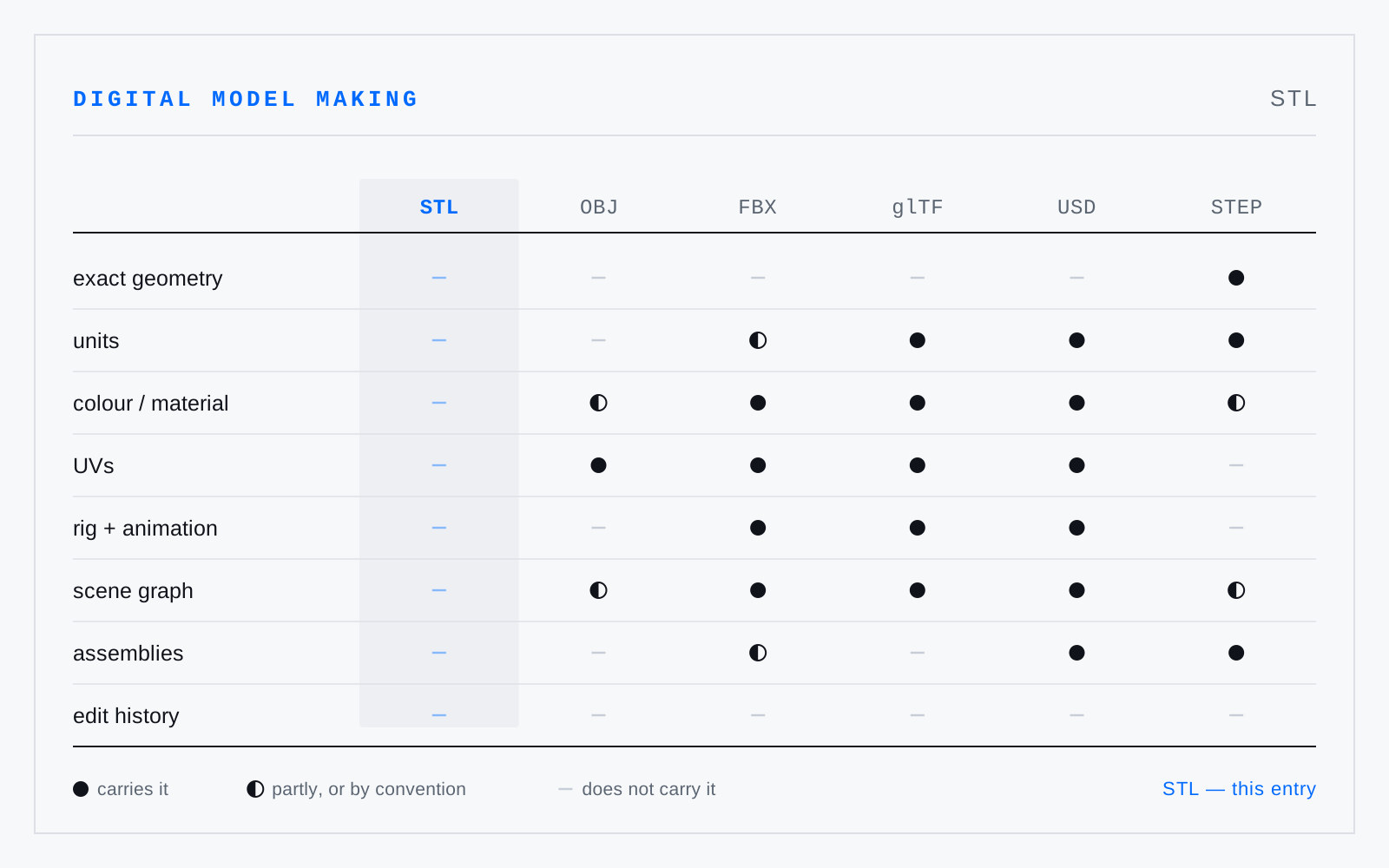
An unstructured list of triangles, each written as three vertices and a normal. That is all: no units, no scale, no colour, no materials, no assemblies, no curves, and no shared vertices — a point is repeated once per triangle touching it. Nothing in the format requires the triangles to form a closed solid.
In practice
Half of all 3D-printing problems are STL problems: wrong scale because there are no units, holes because nothing enforced manifoldness, faceted curves because the tessellation was fixed at export.
Not to be confused with
- OBJA plain-text mesh format carrying vertices, faces of any size, UVs, normals, and material references in a sidecar .mtl file. No animation, no rig, no scene hierarchy, no unit convention. Ubiquitous because it is trivial to parse and everything reads it — not because it is good at anything.
- STEPAn open ISO-standardized CAD exchange format carrying exact B-rep geometry — trimmed spline surfaces, topology, assemblies, units, and in AP242 tolerances and annotation. It has no feature history: you receive an exact solid you can measure and machine, not one you can rebuild by changing a dimension. IGES is its older, surfaces-only ancestor.
Origin
Named for stereolithography, the first commercial 3D-printing process (1987). It was a machine driver's input file, not an interchange format, and was never meant to still be in use forty years on.