Design Nomenclature / Surface & Material
Specular
Also called specular level, specular color, f0, reflectance
This entry has not been translated yet and is shown in English.
In metal/rough conventions, a scalar remapping a dielectric's normal-incidence reflectance — default 0.5 meaning four percent, the top of the range around eight. In spec/gloss conventions, an RGB map giving that reflectance directly, which is also where conductors get their tint.
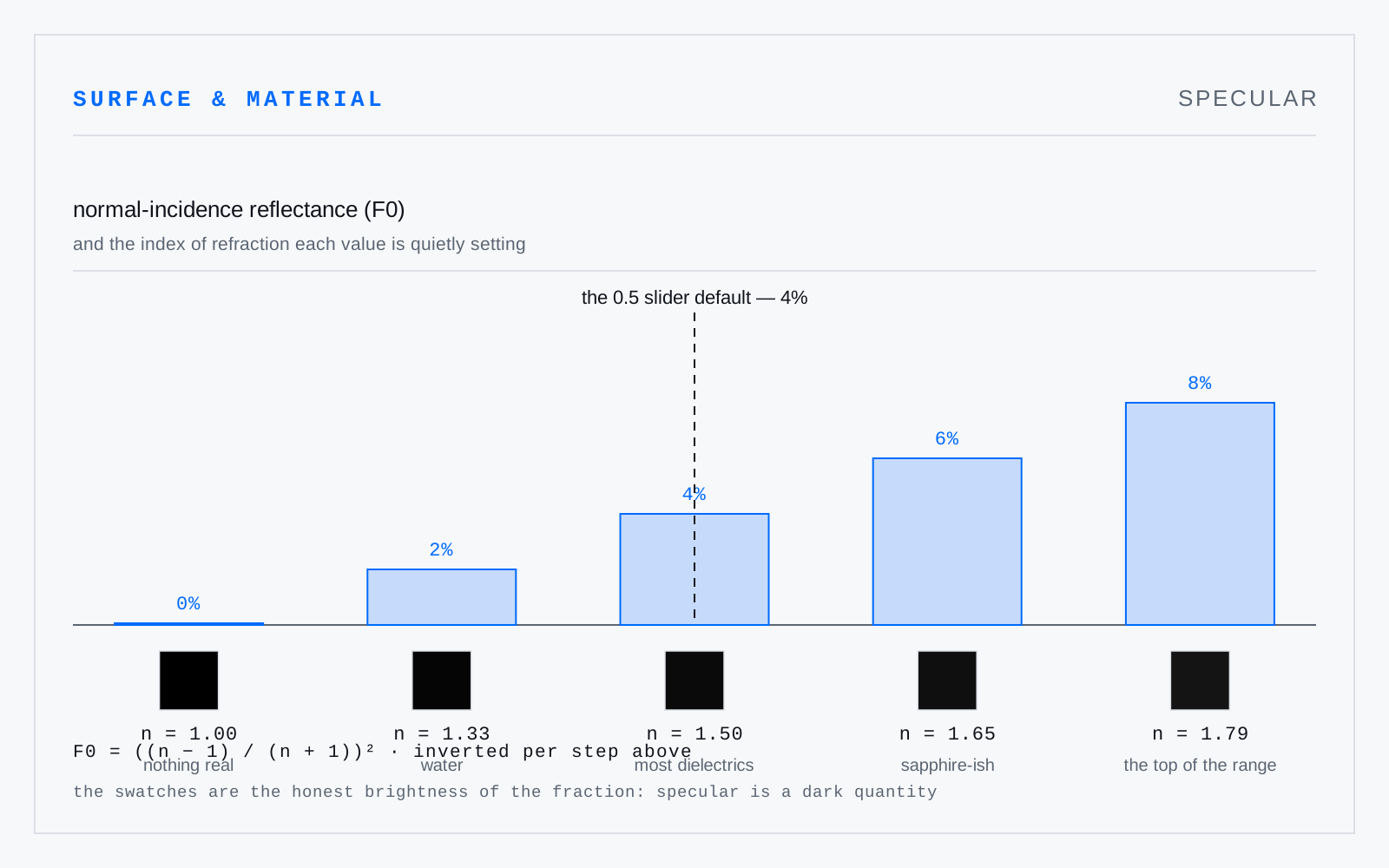
In practice
Four incompatible senses in circulation: F0 to a shader author, the highlight itself to a lighting artist, a lens or surface artifact to a photographer, and a whole map slot to a 2005 game artist.
Not to be confused with
- MetalnessA switch selecting which reflectance model a surface obeys. Conductors have effectively no diffuse response and tint their specular reflection with the base color; dielectrics scatter diffusely and reflect a near-colorless four percent. Intermediate values describe nothing real — they exist to blend across texel boundaries and rust.
- RoughnessThe statistical spread of microfacet normals across a surface, controlling how tightly reflected light clusters around the mirror direction. Low values concentrate energy into a small bright highlight; high values spread the same energy into a broad dim one. It is a distribution width, not a quantity of reflection.
- GlossThe degree to which a surface reflects specularly rather than diffusely — and, unusually for this vocabulary, an actually measured quantity: a gloss meter reads gloss units at a fixed angle, 60° by default, 20° for high gloss, 85° for near-matte. High gloss returns a legible image of the room.
- FresnelThe angle- and wavelength-dependent split of light at a boundary between reflected and transmitted. Reflectance is at its minimum facing the surface — four percent for common dielectrics — and climbs toward total as the angle approaches grazing. Curved forms read as rimmed because their silhouettes present grazing angles, not because edges emit anything.