Design Nomenclature / Surface & Material
Ambient occlusion
Also called ao, occlusion, ao map
This entry has not been translated yet and is shown in English.
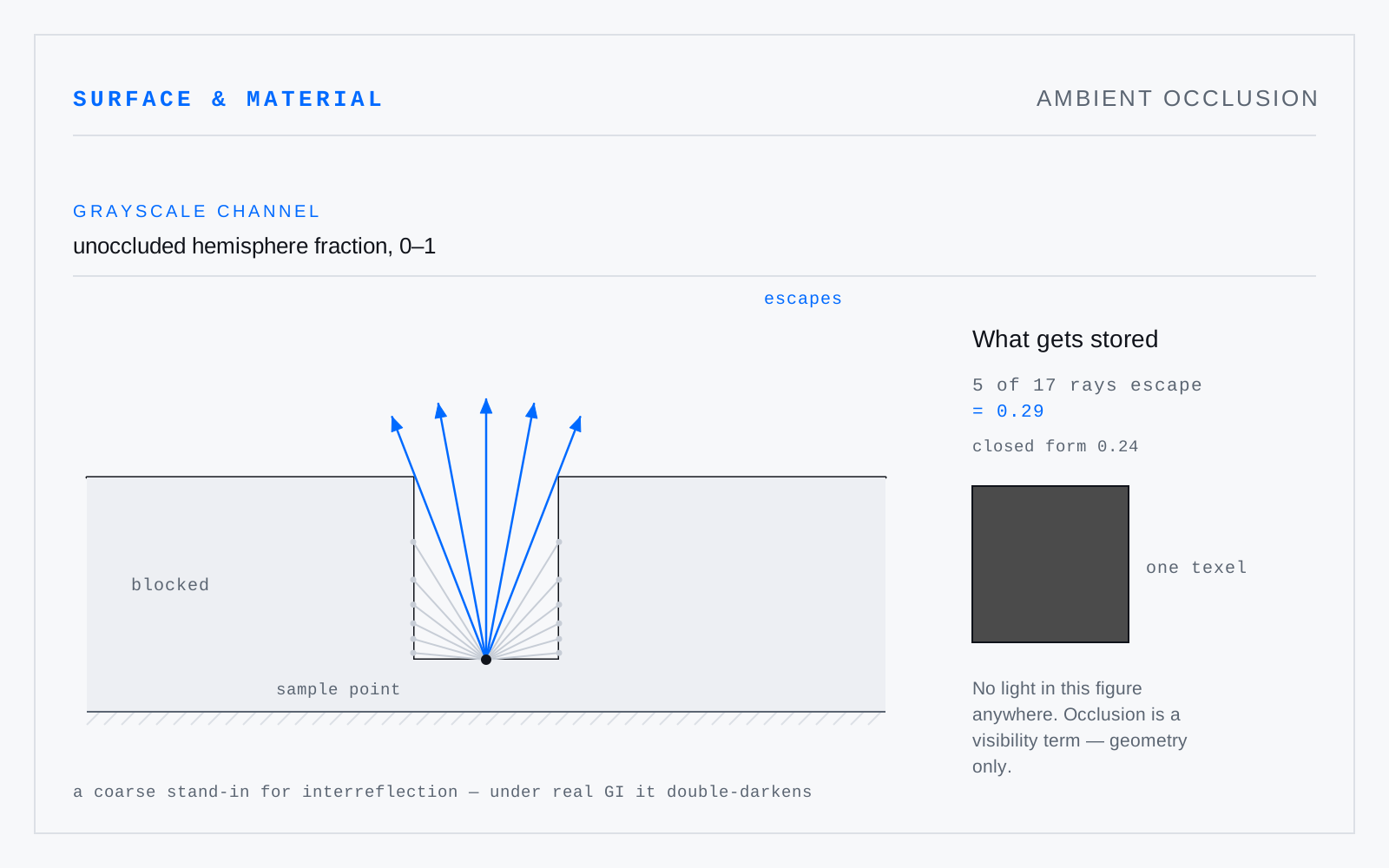
The fraction of the hemisphere above a point blocked by nearby geometry — a purely geometric visibility term, no light involved. As a material channel it attenuates ambient diffuse in creases. Physically it is a coarse stand-in for the interreflection a GI solver computes properly, so under real GI it double-darkens.
In practice
Freely multiplied into everything — diffuse, specular, sometimes the final frame. Only the first is defensible; the rest is contrast the map was never measuring.
Not to be confused with
- Cavity mapA texture recording concavity at detail scale — the tight creases, pits, and panel lines, not the form. Usually multiplied into diffuse or specular to suggest the dirt and light loss that collect in a crevice. Narrower and higher in frequency than ambient occlusion, which measures hemispherical visibility at form scale.
- Cast shadowThe shape an occluder subtracts from another surface's illumination. Unlike a form shadow it has a projected outline governed by the geometry between blocker and receiver: it sharpens as the two approach contact and softens as they separate, regardless of the object's own shading.
- Global illuminationAny solution to light transport accounting for light that arrives after reflecting off other surfaces, not only direct from emitters. It is a category, not an algorithm — radiosity, photon mapping, path tracing, and irradiance caching all compute it, with different biases and different failure modes.