Design Nomenclature / Surface & Material
Gloss
Also called gloss finish, high gloss, gloss units
This entry has not been translated yet and is shown in English.
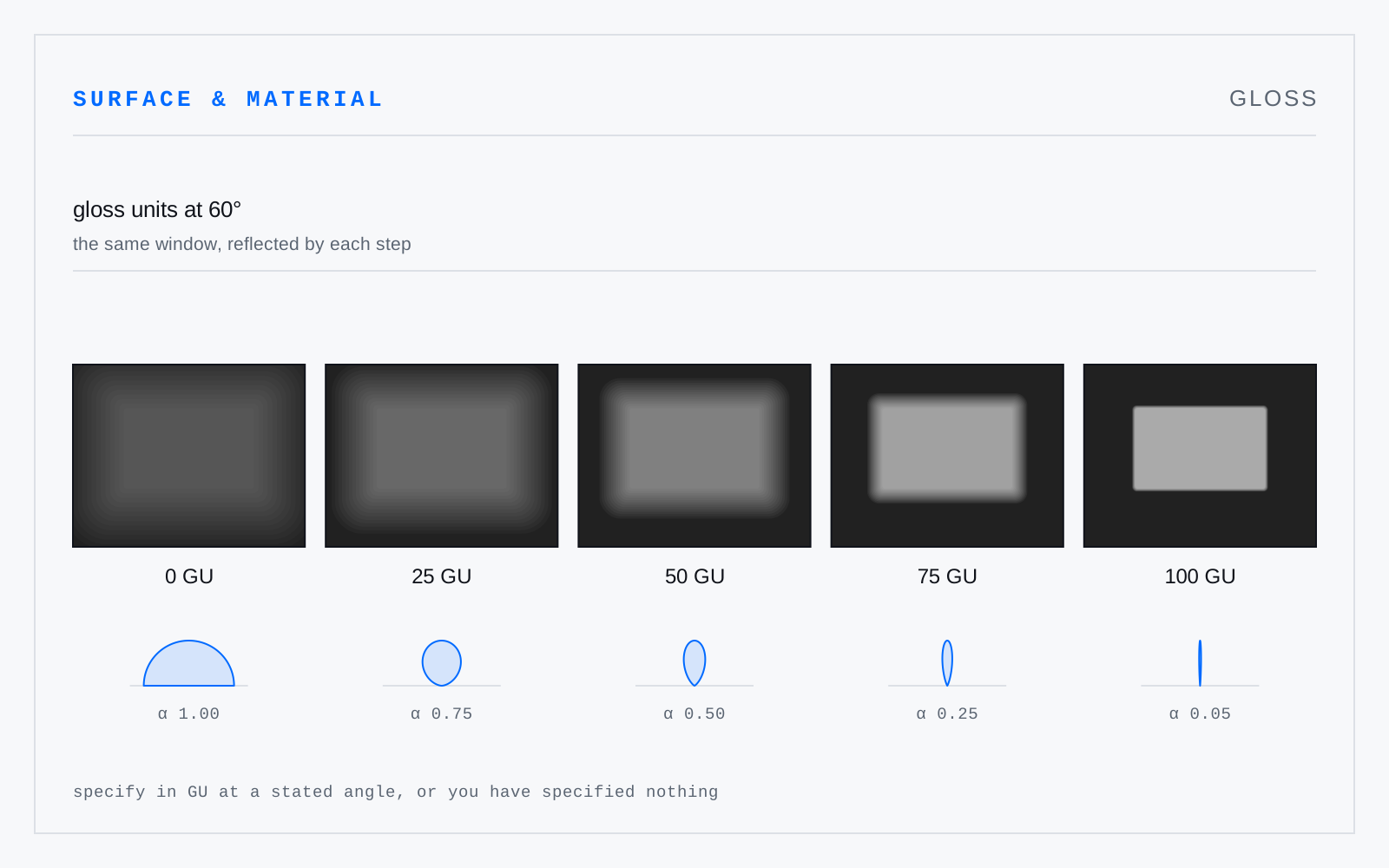
The degree to which a surface reflects specularly rather than diffusely — and, unusually for this vocabulary, an actually measured quantity: a gloss meter reads gloss units at a fixed angle, 60° by default, 20° for high gloss, 85° for near-matte. High gloss returns a legible image of the room.
In practice
Specify in GU at a stated angle or you have specified nothing. "Gloss black" from two vendors will not match, and the mismatch will be visible.
Not to be confused with
- GlossinessThe inverse parameterization of roughness: the same microfacet distribution addressed from the smooth end. High glossiness means a narrow lobe. Conversion is rarely a clean subtraction — pipelines apply their own remap curves or exponents, so a round trip through 1−x will shift the material.
- LusterThe character of a surface's reflected light rather than its quantity. Mineralogy names the kinds — vitreous, metallic, waxy, resinous, greasy, silky, adamantine, dull — and they are not points on one scale. Two surfaces can meter identical gloss and read as entirely different materials, because luster folds in transparency, subsurface scattering, and structure.
- MatteA surface that returns light almost entirely by diffuse scattering, so no image of the environment survives and brightness holds roughly steady as you move. Achieved by micro-roughening — blasting, flatting agents, a coarse sheet. Under 10 gloss units at 60° by common convention, though nobody agrees on the cut.
- SatinThe middle of the gloss ladder: enough specular return to catch a soft highlight, too much scatter to reflect a legible image. The paint trade's rungs — flat, eggshell, satin, semi-gloss, gloss — are marketing names over a continuous gloss-unit scale, and they do not align between manufacturers.