Design Nomenclature / Digital Model Making
Normal Baking
Also called normal map baking, high-to-low bake, projection baking, cage bake
This entry has not been translated yet and is shown in English.
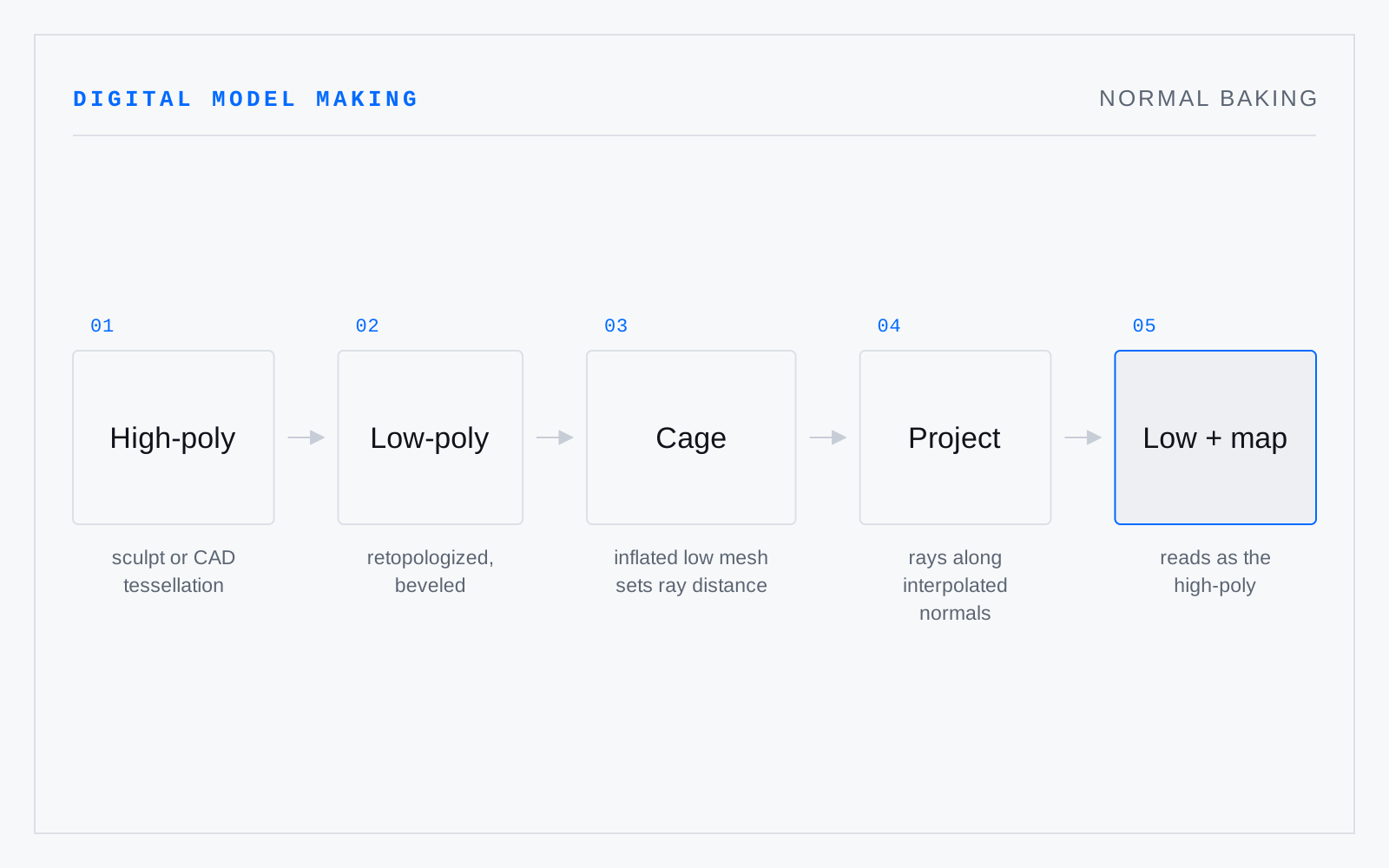
Recording a high-resolution surface's normal direction per texel into a map the low-resolution mesh reads, so a flat face shades as if the detail were there. Rays are cast from the low mesh along its interpolated normals; a cage — an inflated copy of the low mesh — sets how far they search and stops them missing.
In practice
It fails at hard edges unless the low-poly is beveled or split by a matching UV seam: the interpolated normal has nowhere sensible to point. That is where “exploding normals” come from.
Not to be confused with
- Texture BakingPrecomputing a result into a texture indexed by UV, so it is looked up at runtime rather than evaluated. Anything can be baked: lighting, occlusion, curvature, a procedural graph's output, the surface of another mesh. What you buy in cost you pay in flexibility — the result is welded to that geometry and that light.
- Normal mapA texture encoding a perturbed shading normal per texel, XYZ packed into RGB, usually in tangent space so it survives deformation. It changes the vector lighting is computed against without moving a single vertex, so silhouettes stay flat, nothing self-shadows, and the whole illusion fails at grazing angles.
- Displacement mapA texture whose values move real surface points, normally along the normal, so silhouette, occlusion, and cast shadows all change with it. It needs tessellation or ray-level evaluation to pay for. Height and bump maps hold identical data; displacement is the only one that spends it on geometry.