Design Nomenclature / Surface & Material
Satin
Also called eggshell, semi-gloss, silk finish, sheen level, lustre finish
This entry has not been translated yet and is shown in English.
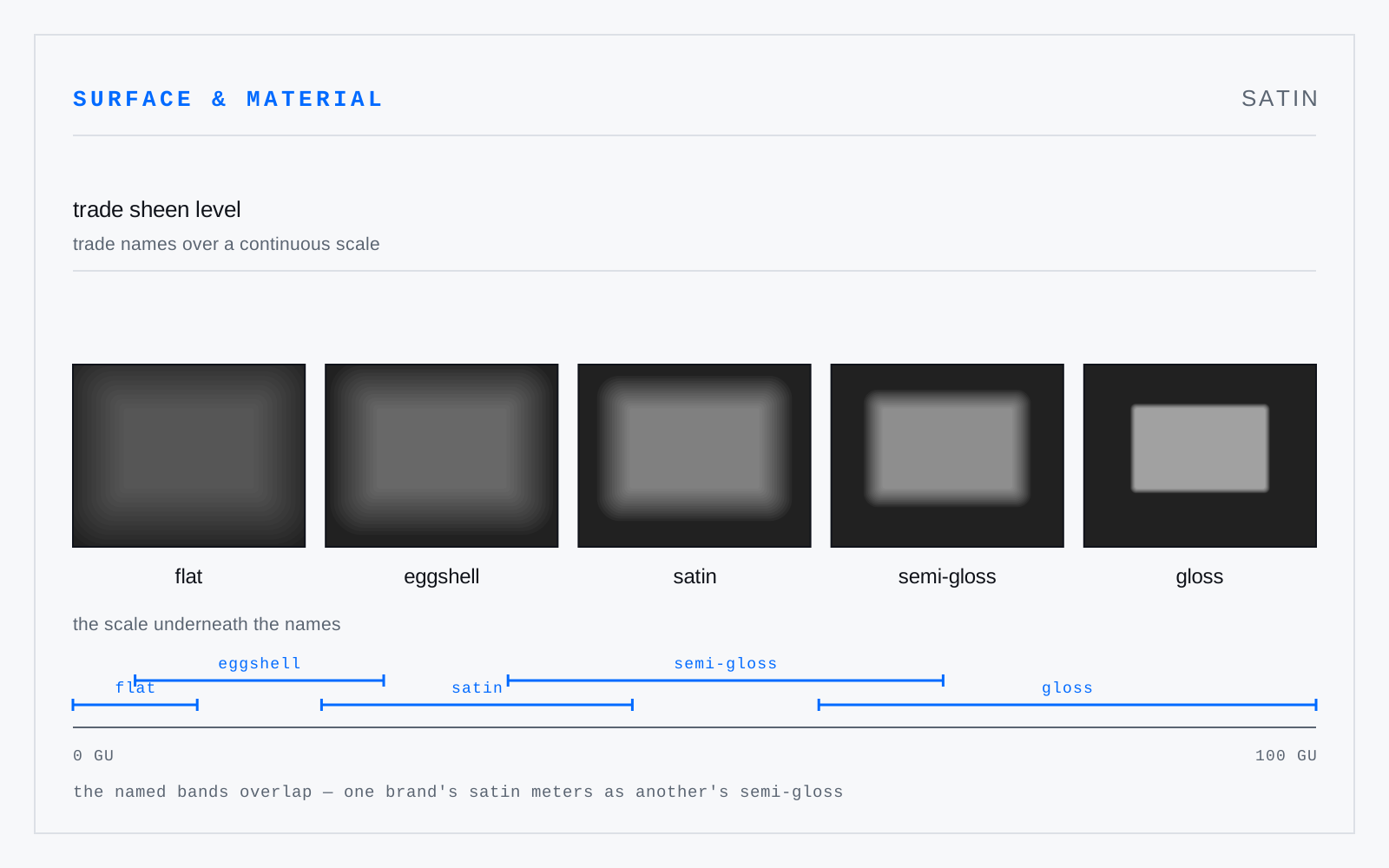
The middle of the gloss ladder: enough specular return to catch a soft highlight, too much scatter to reflect a legible image. The paint trade's rungs — flat, eggshell, satin, semi-gloss, gloss — are marketing names over a continuous gloss-unit scale, and they do not align between manufacturers.
In practice
Eggshell and satin overlap; one brand's satin meters as another's semi-gloss. Compare drawdowns, not names.
Not to be confused with
- MatteA surface that returns light almost entirely by diffuse scattering, so no image of the environment survives and brightness holds roughly steady as you move. Achieved by micro-roughening — blasting, flatting agents, a coarse sheet. Under 10 gloss units at 60° by common convention, though nobody agrees on the cut.
- GlossThe degree to which a surface reflects specularly rather than diffusely — and, unusually for this vocabulary, an actually measured quantity: a gloss meter reads gloss units at a fixed angle, 60° by default, 20° for high gloss, 85° for near-matte. High gloss returns a legible image of the room.
- SheenAn extra grazing-angle lobe layered over the base response to approximate the soft bloom of fabric, where light catches the protruding ends of fibers standing off the surface. In the Disney formulation it is a tuned artistic control with no measured referent; later fiber-scattering models give it a physical basis it did not originally have.
- LusterThe character of a surface's reflected light rather than its quantity. Mineralogy names the kinds — vitreous, metallic, waxy, resinous, greasy, silky, adamantine, dull — and they are not points on one scale. Two surfaces can meter identical gloss and read as entirely different materials, because luster folds in transparency, subsurface scattering, and structure.