Design Nomenclature / Digital Model Making
Point Cloud
Also called cloud, scan data, dense cloud
This entry has not been translated yet and is shown in English.
An unstructured set of measured 3D points, often with colour and estimated normals, and with no connectivity: no edges, no faces, no surface. It is data, not a model. Everything downstream — meshing, normal estimation, hole filling — is inference, and noise, occlusion, and registration error are already in it.
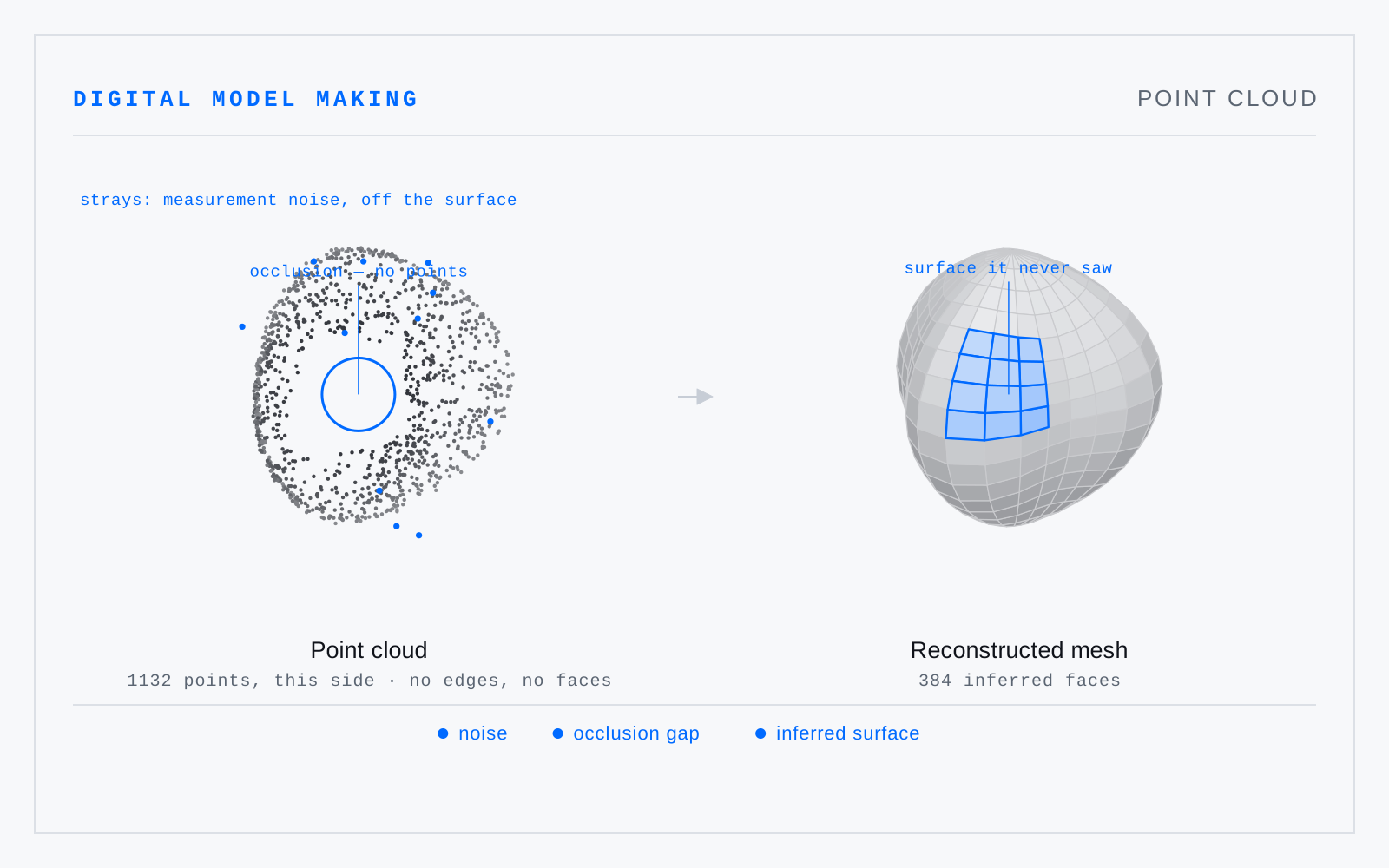
In practice
Renderable directly as splats, and increasingly kept that way. “Cleaning the cloud” means deleting mismeasurement, and it is most of the work.
Not to be confused with
- 3D ScanningMeasuring a real surface directly: structured light projects a known pattern, laser triangulation sweeps a line, time-of-flight times a return. All produce range data in the instrument's own frame, and multiple passes must be registered together. Accuracy here is a specification — unlike photogrammetry's, which is an outcome.
- Voxel ModelingWorking on a regular 3D grid of samples, each cell occupied or carrying a value. Topology changes are trivial — you are editing an array, so self-intersection is not expressible — but resolution is fixed and isotropic, memory scales cubically, and every surface must be extracted by an isosurface pass that leaves a grid signature.
- PhotogrammetryReconstructing geometry from overlapping photographs by matching features across views, solving for camera positions, and triangulating a dense point cloud. It needs texture to match on: matte, detailed, evenly lit surfaces resolve, while gloss, glass, and flat white do not. Scale comes only from a reference placed in the scene.