Design Nomenclature / Digital Model Making
Remesh
Also called remeshing, auto-retopo, voxel remesh, quad remesh
This entry has not been translated yet and is shown in English.
Replacing a mesh's topology wholesale with a new, evenly distributed one approximating the same surface. Voxel remeshers rasterize to a grid and re-extract, guaranteeing watertightness and losing everything below cell size; quad remeshers fit a quad field, optionally guided, and get closer to a layout someone could work with.
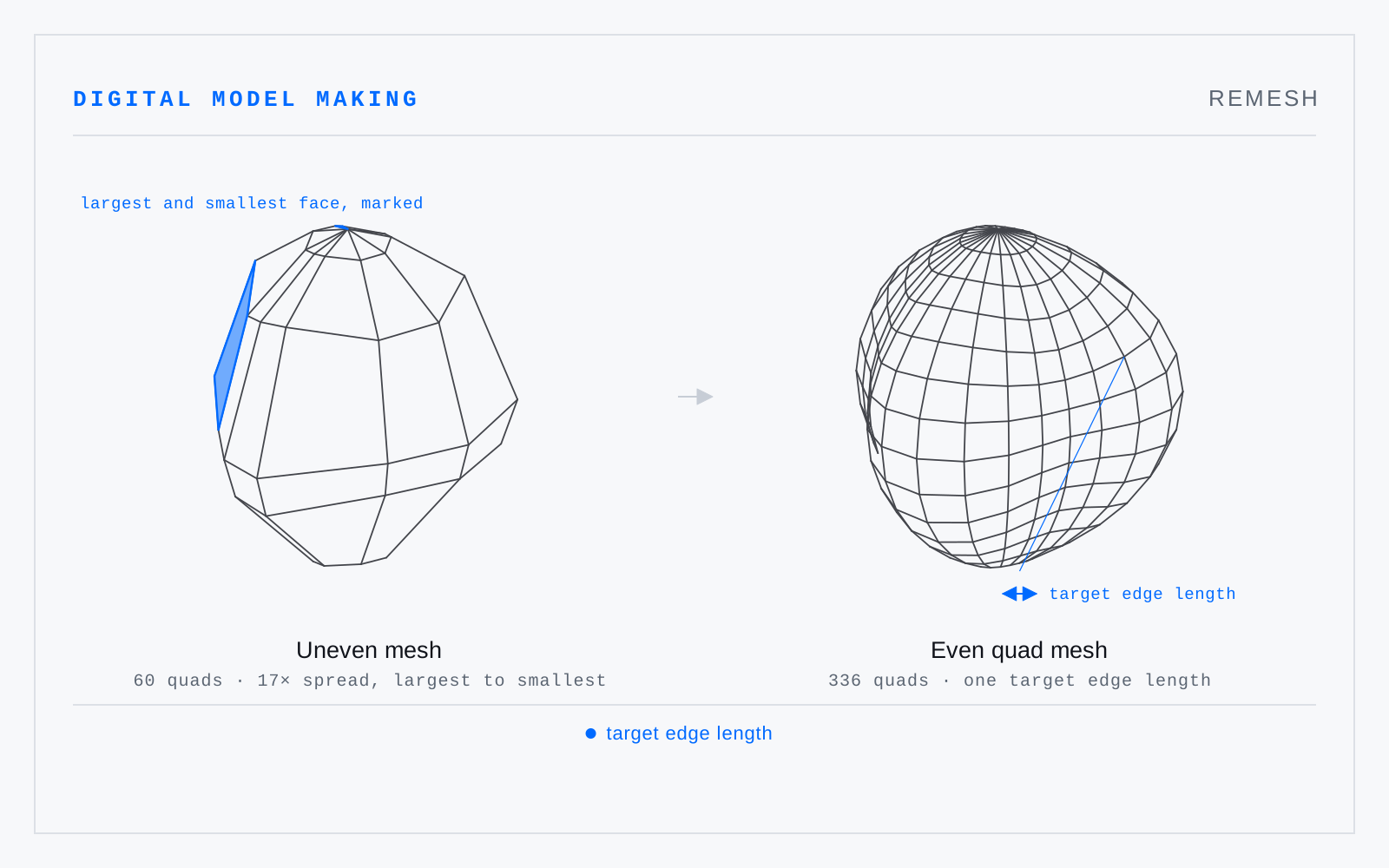
In practice
Unqualified, it means voxel remesh in a sculpting app — a repair operation. Quad remesh is an attempt at retopology, and it is only as good as its guide curves.
Not to be confused with
- RetopologyBuilding a new, deliberately laid-out mesh over an existing surface, by hand or with guided automation. The goal is not fewer polygons; it is edge flow that deforms correctly, loops that follow the anatomy or the feature lines, and a quad-dominant cage that subdivides cleanly. Detail returns by baking.
- DecimateReducing triangle count by collapsing edges in order of how little each collapse changes the surface, usually by a quadric error metric. Silhouette is preserved; layout is not. The output is an irregular triangle soup that deforms badly and unwraps worse — correct for a static prop, wrong for anything that moves.
- Voxel ModelingWorking on a regular 3D grid of samples, each cell occupied or carrying a value. Topology changes are trivial — you are editing an array, so self-intersection is not expressible — but resolution is fixed and isotropic, memory scales cubically, and every surface must be extracted by an isosurface pass that leaves a grid signature.