Design Nomenclature / Digital Model Making
Bevel (modifier)
Also called bevel tool, edge bevel, bevel modifier
This entry has not been translated yet and is shown in English.
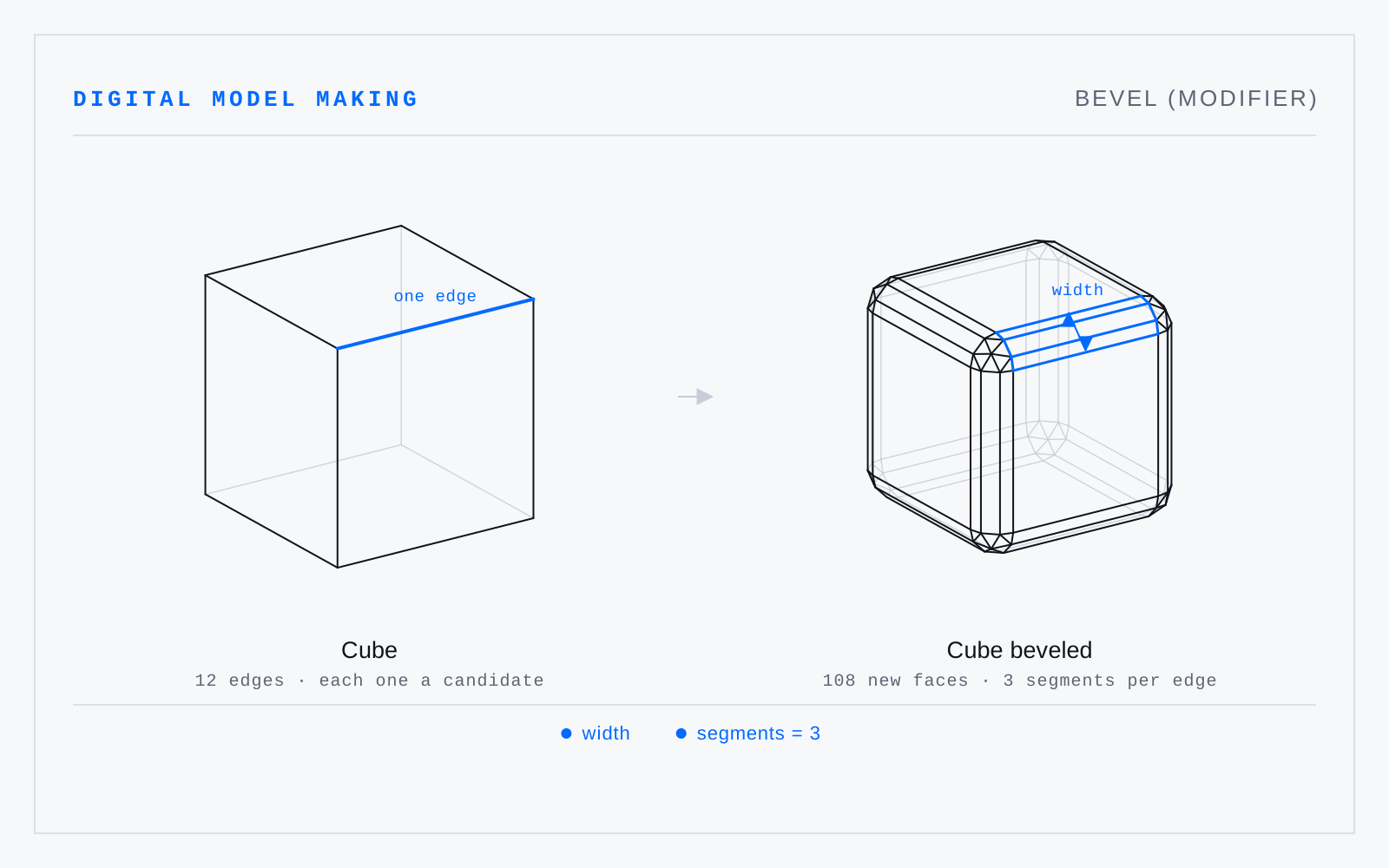
A procedural operation replacing each selected edge with a strip of faces at a set width and segment count — one segment reads as a chamfer, several as a fillet. Because it works on topology rather than solid geometry, it fails wherever the offset self-intersects: thin walls, tight corners, converging edges.
In practice
“Bevel everything” is doctrine because no real edge is perfectly sharp and a one-pixel highlight is the whole point. CAD expresses the same intent as a fillet feature, and it is not the same tool.
Not to be confused with
- ChamferA flat facet cutting across an edge at an angle — typically 45°, and specified as a distance and an angle rather than as a radius. It meets both adjoining faces at a hard line: G0, not tangent. Its purpose is to break a sharp arris for safe handling and to lead a fastener or a mating part into place.
- FilletA rounded transition replacing a sharp edge, generated by rolling a circle of fixed or varying radius into the corner and trimming both faces back to where it touches. Tangent to both surfaces by construction — G1 at minimum. It removes the stress concentration at an interior corner, so it is a structural feature before it is a cosmetic one.
- Support LoopAn extra edge loop placed close to a hard edge so subdivision cannot round it away — the tighter the loop, the sharper the result. It costs geometry and complicates topology, but survives export, deformation, and every renderer, which is why production meshes use it instead of creases.