Design Nomenclature / Surface & Material
Fresnel
Also called fresnel effect, fresnel reflectance, fresnel term
The angle- and wavelength-dependent split of light at a boundary between reflected and transmitted. Reflectance is at its minimum facing the surface — four percent for common dielectrics — and climbs toward total as the angle approaches grazing. Curved forms read as rimmed because their silhouettes present grazing angles, not because edges emit anything.
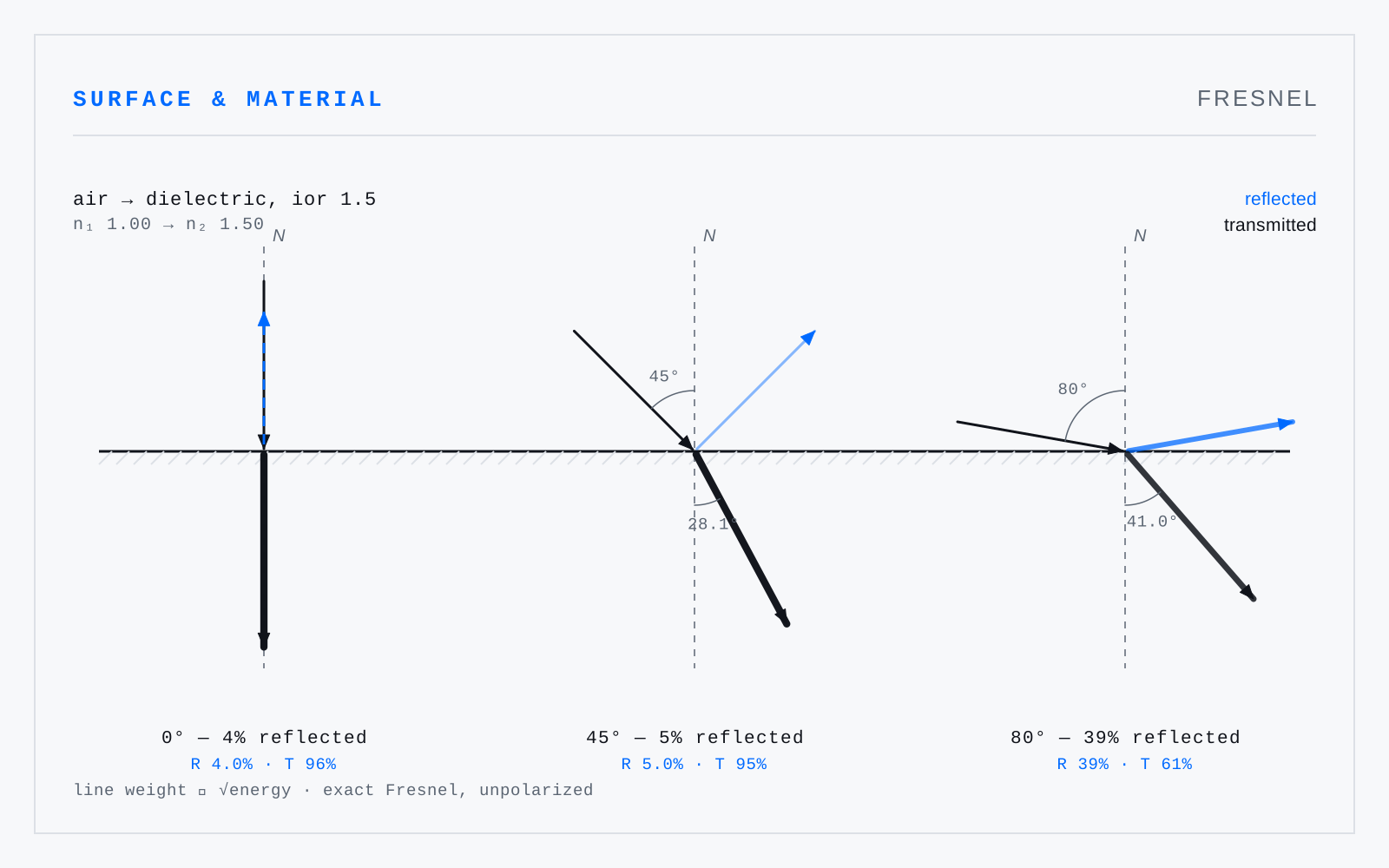
In practice
"Add some Fresnel" usually means a rim term hacked in by hand. In a correct BRDF it is not optional and not a look — it is already there.
Not to be confused with
- SpecularIn metal/rough conventions, a scalar remapping a dielectric's normal-incidence reflectance — default 0.5 meaning four percent, the top of the range around eight. In spec/gloss conventions, an RGB map giving that reflectance directly, which is also where conductors get their tint.
- SheenAn extra grazing-angle lobe layered over the base response to approximate the soft bloom of fabric, where light catches the protruding ends of fibers standing off the surface. In the Disney formulation it is a tuned artistic control with no measured referent; later fiber-scattering models give it a physical basis it did not originally have.
- EmissiveRadiance a surface produces on its own, independent of anything illuminating it — a screen, an LED, hot metal. In most real-time pipelines it only writes color into the frame and lights nothing around it. Whether it acts as an actual light source is a property of the renderer, not the material.
Origin
For Augustin-Jean Fresnel, who derived the reflection and transmission equations in the 1820s while establishing the wave theory of light.