Design Nomenclature / Digital Model Making
Solid Modeling
Also called b-rep, B-Rep, boundary representation
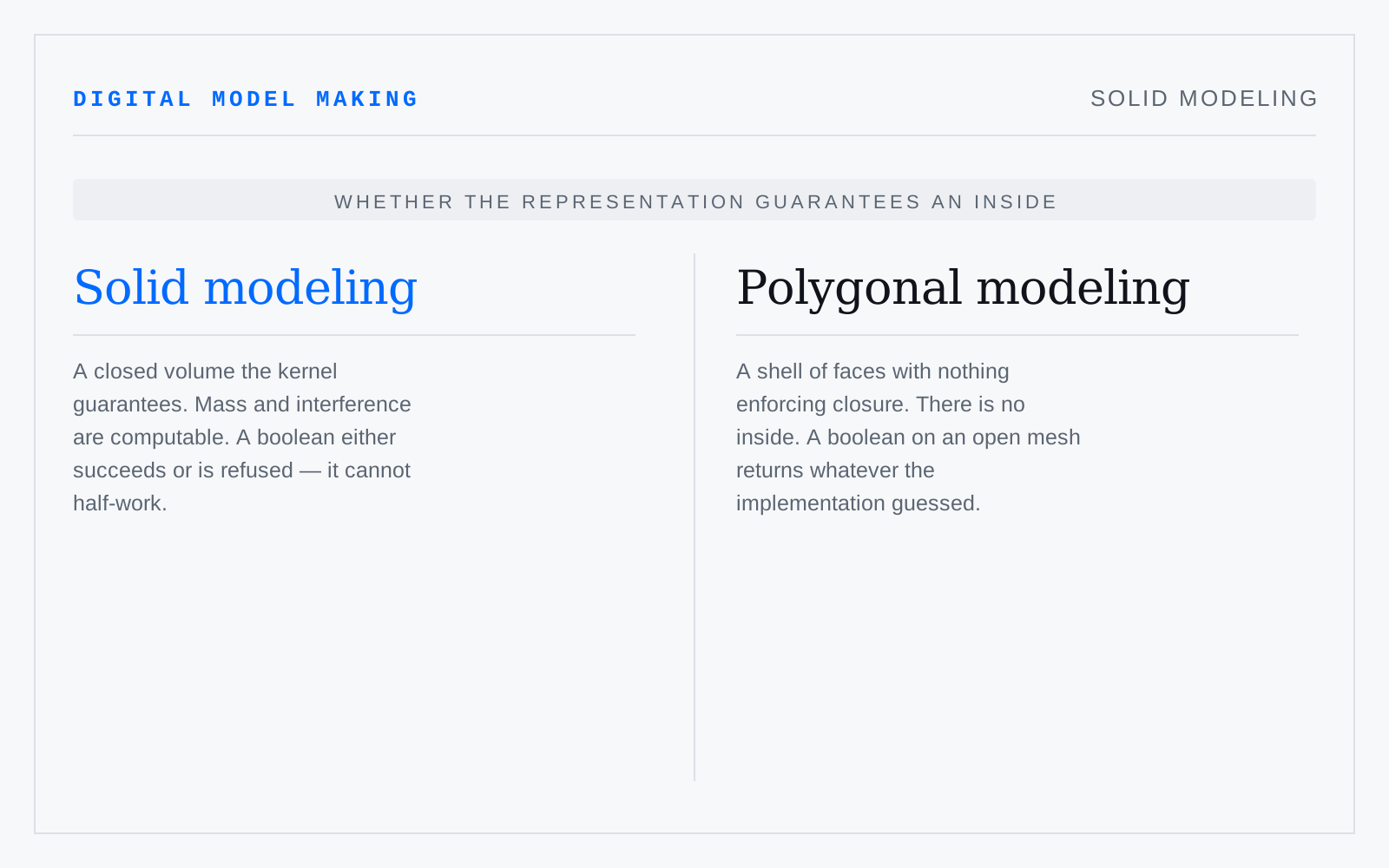
Representing a part as a closed watertight volume: trimmed faces stitched along shared edges, with an inside and an outside the kernel can guarantee. Volume, mass, and interference become computable. Every operation is validated against that closure, which is why a CAD boolean either succeeds cleanly or refuses.
In practice
“B-rep” names the representation, “solid modeling” the practice. Mechanical CAD is solid by default; the surfacing tools exist for where it fails.
Not to be confused with
- Polygonal ModelingBuilding form from an explicit mesh of vertices, edges, and faces, moved and cut by hand. The mesh is the final surface, so its resolution is decided up front — a cylinder is faceted at whatever segment count you gave it. Fast, direct, and indifferent to mathematical exactness.
- NURBS ModelingBuilding form as a patchwork of mathematically exact rational spline surfaces, each a grid of control points with a degree and a knot vector. Resolution is evaluated on demand, so the surface is exact at any zoom. The work is patch layout, and holding continuity where patches meet.
- CSGA scheme in which form is a tree of primitives combined by set operations, and the tree — not the resulting surface — is the model. Evaluate it and you get geometry; keep it and you can still change the radius of a hole from twenty steps back.