Design Nomenclature / Surface & Material
Glossiness
Also called gloss map, smoothness, shininess
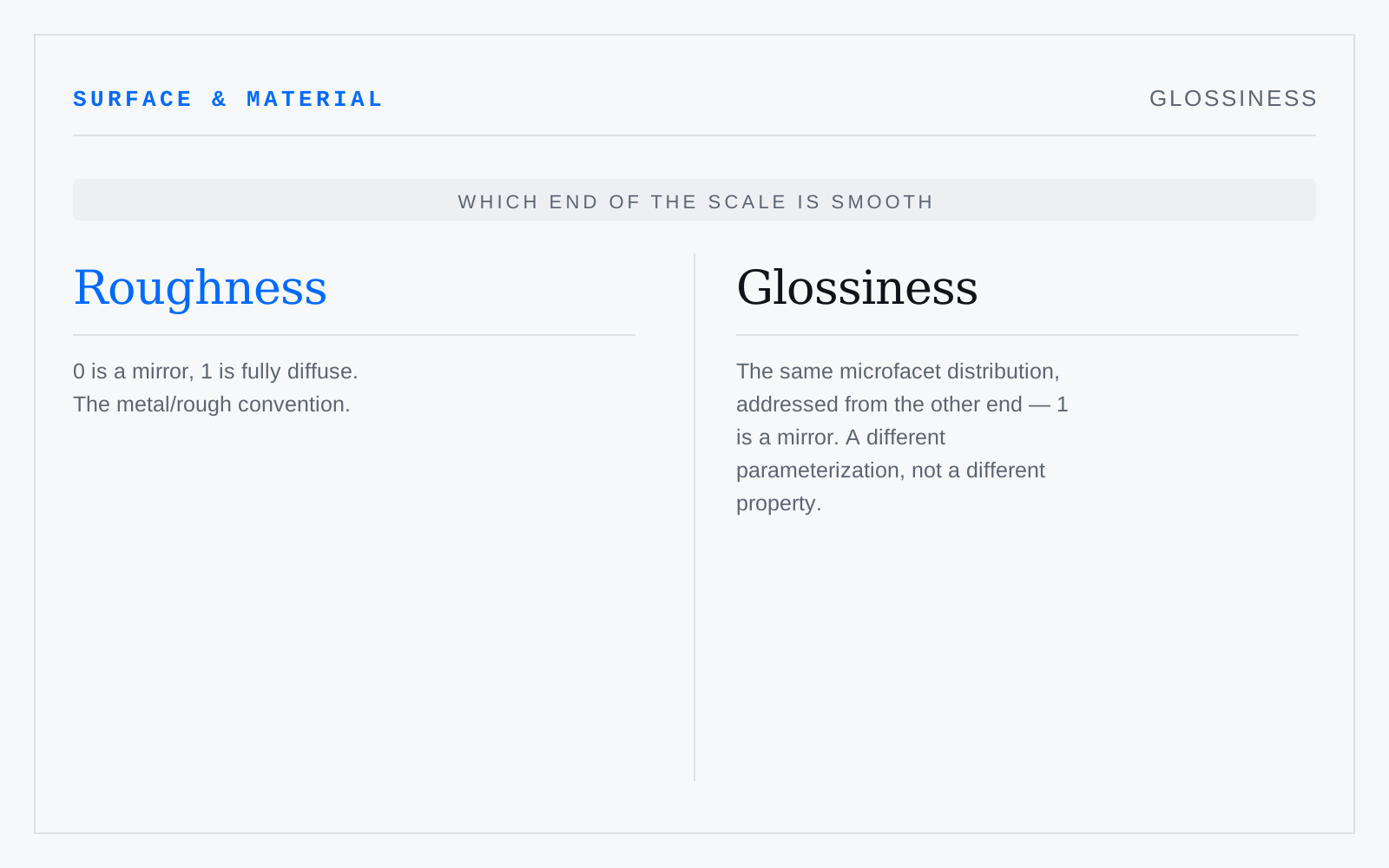
The inverse parameterization of roughness: the same microfacet distribution addressed from the smooth end. High glossiness means a narrow lobe. Conversion is rarely a clean subtraction — pipelines apply their own remap curves or exponents, so a round trip through 1−x will shift the material.
In practice
Marks which workflow someone learned in. Spec/gloss and metal/rough describe substantially the same model; neither is the physical one.
Not to be confused with
- RoughnessThe statistical spread of microfacet normals across a surface, controlling how tightly reflected light clusters around the mirror direction. Low values concentrate energy into a small bright highlight; high values spread the same energy into a broad dim one. It is a distribution width, not a quantity of reflection.
- GlossThe degree to which a surface reflects specularly rather than diffusely — and, unusually for this vocabulary, an actually measured quantity: a gloss meter reads gloss units at a fixed angle, 60° by default, 20° for high gloss, 85° for near-matte. High gloss returns a legible image of the room.
- LusterThe character of a surface's reflected light rather than its quantity. Mineralogy names the kinds — vitreous, metallic, waxy, resinous, greasy, silky, adamantine, dull — and they are not points on one scale. Two surfaces can meter identical gloss and read as entirely different materials, because luster folds in transparency, subsurface scattering, and structure.