Design Nomenclature / Surface & Material
Luster
Also called lustre, sheen quality
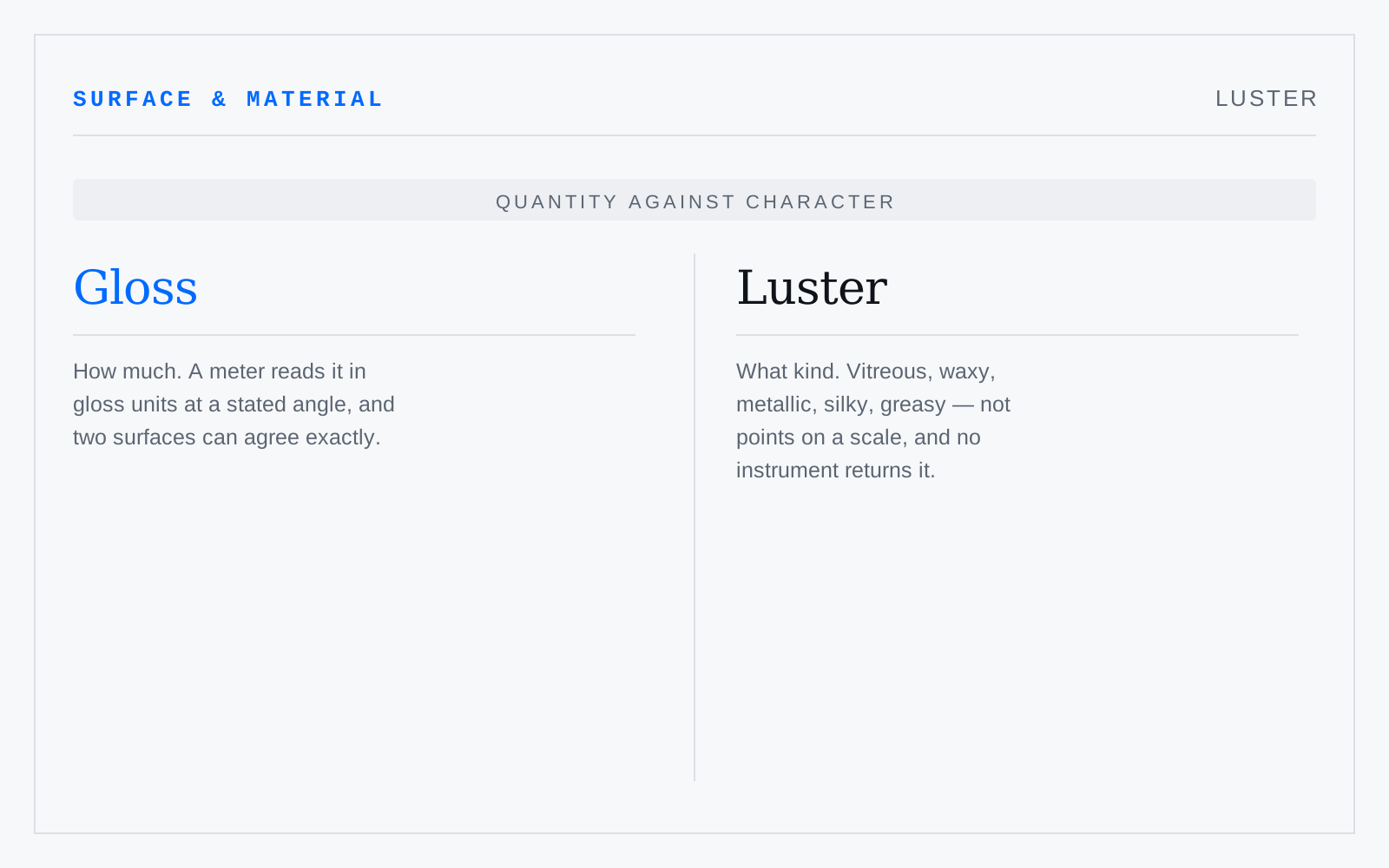
The character of a surface's reflected light rather than its quantity. Mineralogy names the kinds — vitreous, metallic, waxy, resinous, greasy, silky, adamantine, dull — and they are not points on one scale. Two surfaces can meter identical gloss and read as entirely different materials, because luster folds in transparency, subsurface scattering, and structure.
In practice
The most useful word in the domain and the least used, because it is qualitative and nobody can spec it. Say it anyway — gloss units cannot carry it.
Not to be confused with
- GlossThe degree to which a surface reflects specularly rather than diffusely — and, unusually for this vocabulary, an actually measured quantity: a gloss meter reads gloss units at a fixed angle, 60° by default, 20° for high gloss, 85° for near-matte. High gloss returns a legible image of the room.
- GlossinessThe inverse parameterization of roughness: the same microfacet distribution addressed from the smooth end. High glossiness means a narrow lobe. Conversion is rarely a clean subtraction — pipelines apply their own remap curves or exponents, so a round trip through 1−x will shift the material.
- SheenAn extra grazing-angle lobe layered over the base response to approximate the soft bloom of fabric, where light catches the protruding ends of fibers standing off the surface. In the Disney formulation it is a tuned artistic control with no measured referent; later fiber-scattering models give it a physical basis it did not originally have.
- PearlescenceThe soft, layered glow of many thin platelets — mica, nacre, coated flakes — suspended at varied depths beneath a translucent surface, each catching light at a slightly different plane. The angular shift is broad and low in saturation, and the depth comes from the spread of the platelets, not from any single reflection.