Design Nomenclature / Systems & Spec
Contrast ratio
Also called WCAG contrast, luminance contrast ratio, contrast check
(L1 + 0.05) / (L2 + 0.05), where L is WCAG relative luminance and L1 is the lighter of the two colours. It runs from 1:1 to 21:1. Hue is discarded entirely — only luminance survives the formula — so two pairs at identical ratios can differ enormously in how readable they look.
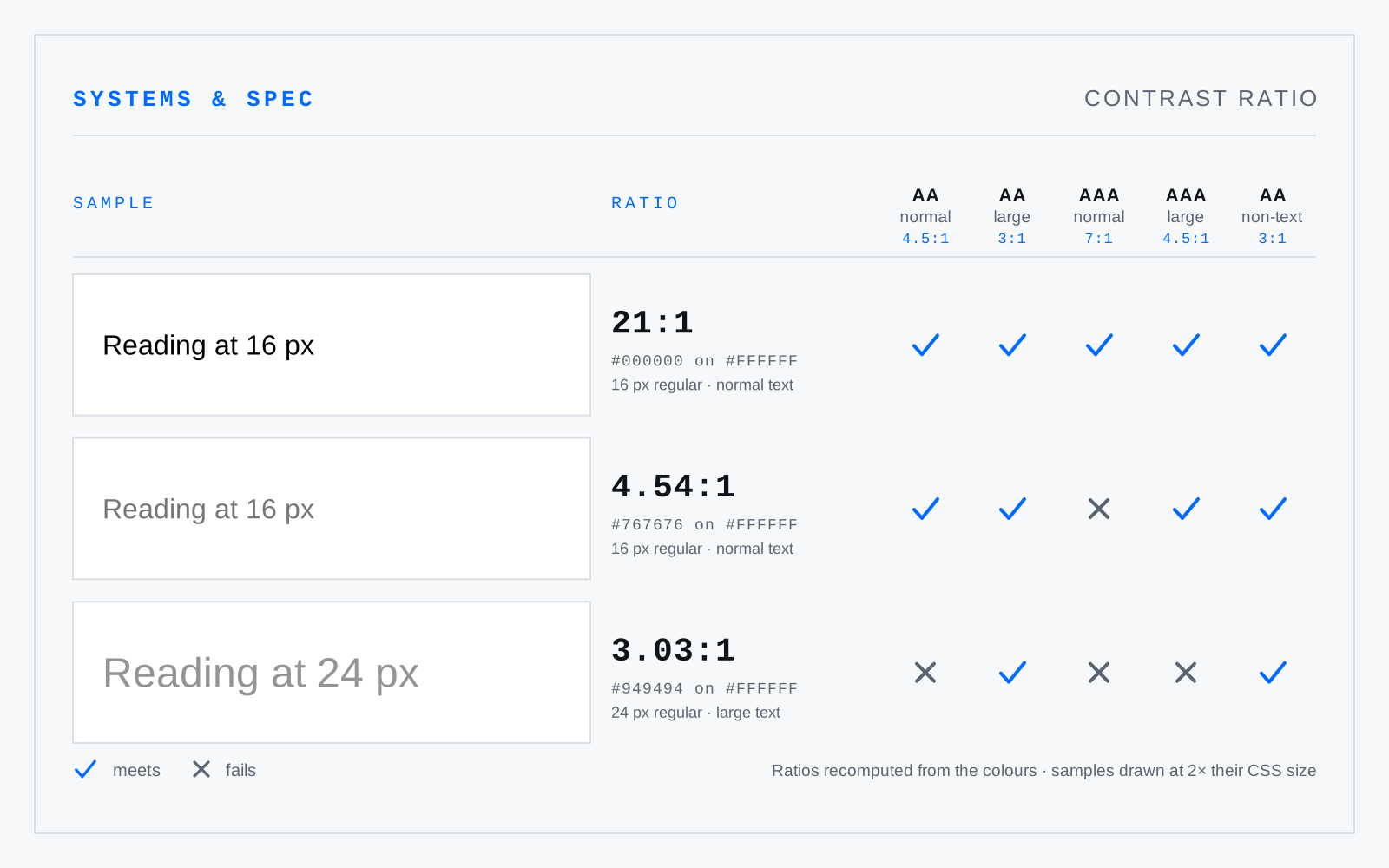
In practice
Quoted as a property of a colour pair, which it is, then as a property of a design, which it is not: it says nothing about size, weight, or the surface underneath.
Not to be confused with
- Relative luminanceThe quantity WCAG contrast is computed from: sRGB channels linearised through the transfer function, then weighted 0.2126 R + 0.7152 G + 0.0722 B to a value between 0 and 1. It approximates measured light, not perceived lightness, and models dark backgrounds badly — which is why light-on-dark text often passes while reading worse than the number promises.
- APCAA contrast model developed for WCAG 3 that reports a polarity-aware lightness contrast value, Lc, rather than a ratio, and factors in text size and weight. It exists because WCAG 2.x contrast handles dark backgrounds poorly. It is a candidate in a working draft — nothing conforms to APCA, and it replaces no shipped criterion.
- LuminanceRadiance weighted by the eye's photopic sensitivity and integrated over wavelength — candela per square metre. It measures light leaving a surface toward the observer, is what a display's peak-brightness spec quotes, and is linear in energy, so equal steps in it are not equal steps in appearance.