Design Nomenclature / Color
Saturation
Also called vividness, purity
- Color
- Light & Optics
- 2D & 3D
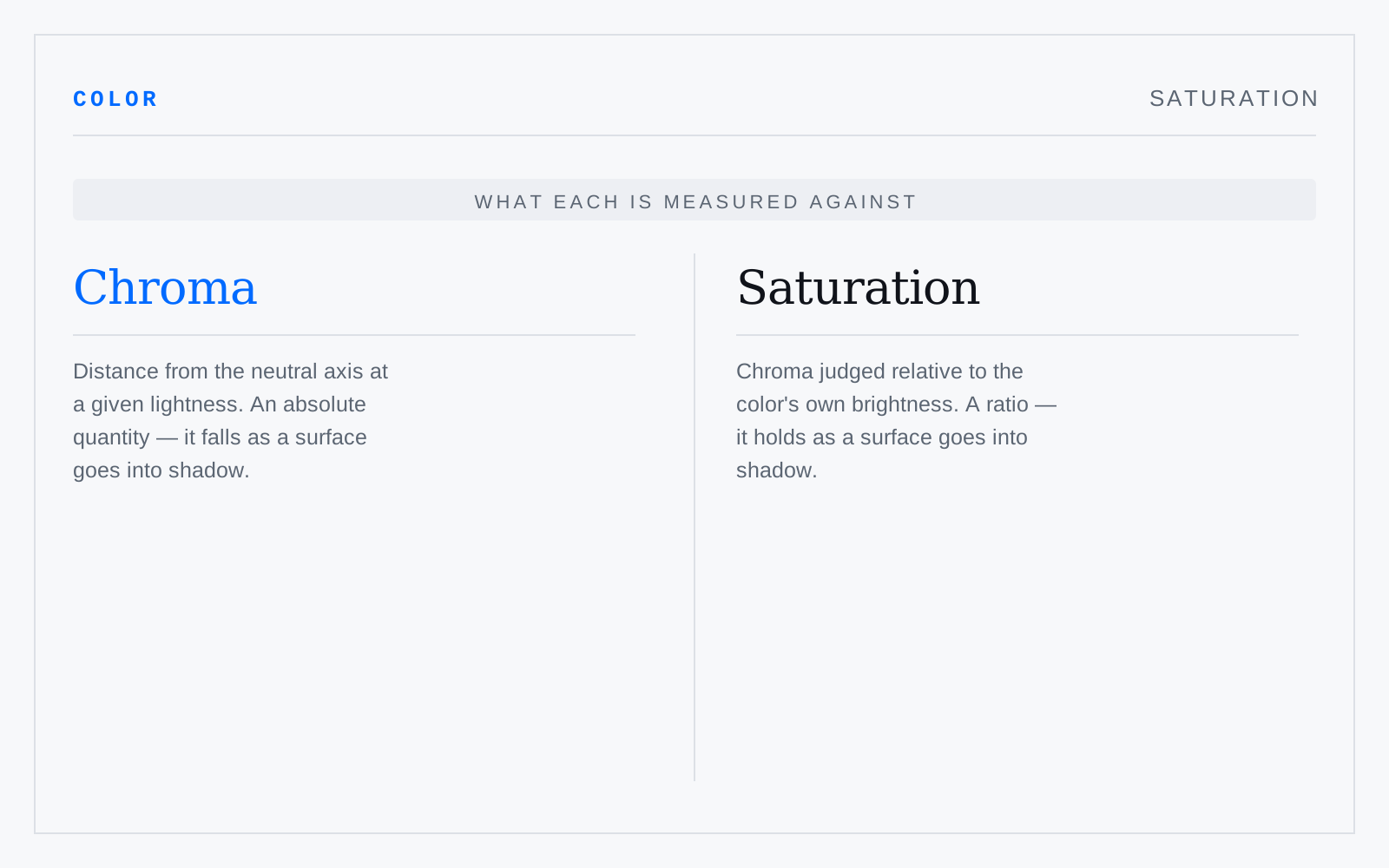
Chroma judged relative to the color's own brightness — how vivid it appears given how light it is. Being a ratio rather than a distance, saturation holds roughly constant down a shadow gradient where chroma falls: a red wall in shade loses chroma but keeps saturation, which is why it still reads as the same red.
In practice
Studio speech uses it for everything from chroma to colorfulness. The HSL and HSB 'S' channels are neither — they are geometric conveniences that share a name.
Not to be confused with
- ChromaThe strength of a color measured against a neutral grey of the same value — how far it sits from the achromatic axis. Chroma is an absolute distance, so its ceiling is not uniform: it varies with hue and with value, which is why a Munsell chroma of 10 is near-maximal for a blue-green and unremarkable for a red.
- HSLA cylindrical remapping of RGB into hue, saturation, and lightness, with L running 0 to 100% and every fully saturated hue landing at L 50%. That is a fact about the geometry, not about perception: HSL yellow and HSL blue at L 50% differ enormously in the lightness anyone actually sees.
- HSBRGB remapped to hue, saturation, and brightness, where B 100% is the brightest the display can render that hue — so pure yellow and pure blue both sit at B 100%. The model is a hexcone where HSL is a bicone. Neither is perceptual, and their S channels are not the same quantity.